ESS 뉴스
키워드 ESS 결과입니다.
-
 세계
세계Who will care for Korea's elderly? Foreign workers enter troubled market
As South Korea turns to foreign students to fill a shortage of caregivers, experts warn that bringing in new workers without first improving pay, conditions and career prospects could leave the underlying crisis unresolved Foreign students at Seojeong University in Yangju, Gyeonggi Province, practice repositioning a patient as part of a caregiver training course. (Seojeong University) South Korea’s rapidly aging population has created an issue that is at once demographic and deeply personal: Who will care for the growing number of older people? The arithmetic appears daunting. Korea is projected to face a shortfall of roughly 116,000 eldercare workers by 2028, according to government data. The Health Ministry estimates the country will need 990,000 additional caregivers by 2043. Yet beneath that headline shortage lies a contradiction. Nearly 2.3 million people have obtained caregiver qualifications but are not working in the field, according to the care workers’ union affiliated with the Korean Confederation of Trade Unions. That has led workers and labor experts to question whether Korea simply lacks people capable of providing care — or whether it lacks care jobs attractive enough for people to enter and remain in. As policymakers search for ways to expand the care workforce, one increasingly prominent part of their strategy is to open new pathways for foreign residents and international students. With Korea firmly a super-aged society and demand for elderly care rising, the government has begun creating routes for international students to train as caregivers and remain in the country for work. But if poor pay and working conditions are part of what keeps qualified Koreans out of the sector, another question follows: Will those same jobs prove attractive enough for the foreign students now being recruited to fill them? A shortage of workers — or of good jobs? Care work occupies a paradoxical place in Korea’s labor market. Society increasingly depends on it, yet the work remains relatively poorly compensated and socially undervalued. Workers assist with some of the most intimate parts of daily life — bathing, toileting, feeding and mobility — while also performing emotional labor for elderly people suffering from loneliness, dementia and declining health. Yet the occupation offers little career progression, and workloads can be severe. "Although stereotypes against caregivers have subsided, the job remains difficult compared with other careers," Jeon Hyun-wook, head of the KCTU-affiliated care workers’ union, told The Korea Herald. Caregivers are generally paid around the minimum wage, with pay rising largely in line with increases in the statutory minimum. There is no wage system recognizing seniority or accumulated experience, while night shifts and overtime are difficult to avoid at nursing homes that operate around the clock. Jeon said those conditions help explain why many qualified workers stay away from the field. "We keep telling authorities that there needs to be better treatment," he said. Lee Kyu-yong, a senior researcher at the Korea Labor Institute, said the large pool of inactive certificate holders suggests Korea’s shortage cannot be explained simply by a lack of qualified people. "There are a great many Koreans who hold caregiver qualifications," Lee told The Korea Herald. "They are not going into the field because the wages and working conditions are poor." For Lee, the problem is one of sequencing. "Improving caregivers' working conditions should come first," he said, questioning whether bringing in foreign workers should precede efforts to make the existing jobs more sustainable. Kim Ok-nyu, a Sookmyung Women's University professor who studies migration and care work, put the problem more bluntly. "The care sector is already one of the occupations Koreans avoid," Kim said. "If Koreans don't want to do the work, migrants won't necessarily want to do it either." That is the central risk facing Korea’s new strategy. Migration may expand the pool of potential workers, but it does not by itself make care work more attractive. Looking abroad for caregivers To address the looming shortage, the Justice Ministry and the Health Ministry announced in March 2025 that 24 universities nationwide would be allowed to operate degree programs for foreign students seeking caregiver qualifications from 2026. Under the two-year pilot program, designated universities can establish departments for international students and offer degree courses leading to caregiver certification. The curriculum must follow government guidelines and include customized Korean-language training. The government has also introduced visa-related incentives aimed at recruitment and settlement. “With a shortage of caregivers expected going forward, the foreign caregiver training university program could serve as a way to secure a stable workforce,” Health Minister Jeong Eun-kyeong said when the program was announced. For policymakers, international students offer a potential source of long-term workers. They are younger than much of the existing caregiver population, can build Korean-language skills while studying and may remain in Korea after graduation. For students themselves, the program can also create opportunities that did not previously exist. For 37-year-old Uyanga, a Mongolian student studying global nursing at Sahmyook Health University, the new track has offered a chance to pursue both a new career and long-term settlement in Korea. "I heard it is difficult to obtain a D-2 visa past your late 20s," Uyanga told local media. "I am now able to study what I enjoy in Korea, a country I was always interested in." Uyanga majored in veterinary medicine in Mongolia and later worked at a processed-food factory testing chemical treatments. She said she had long wanted to work in social welfare, particularly elderly care. "I am confident that I can provide care and support services to elderly people better than anyone," she said. "I had a strong desire to work in social welfare, especially in elderly care." For students like Uyanga, the program offers something tangible. It provides a degree, a profession and a possible path to staying in Korea. But the same conditions that deter Koreans will still be waiting for them after graduation. Can migration work without reform? Both Kim and Lee questioned whether the government has sufficiently prepared for what happens after those students graduate. Kim said students entering the new tracks may not have been given a realistic picture of the wages and working conditions awaiting them. "They aren't necessarily studying with an accurate understanding of the working conditions or wages they will face as caregivers," she said. Kim said some students could arrive expecting wages in Korea to translate into greater purchasing power than they actually provide once housing, food and other living costs are taken into account. The program also contains a built-in mismatch. Foreign students are being asked to complete college-level programs to enter an occupation whose Korean certification system currently has no requirement for academic qualifications. Kim questioned whether the sector has created a wage and career structure capable of recognizing that additional education. "If someone has earned at least an associate degree, are they going to receive the same pay as someone with no educational requirement?" Kim said. "The wage system itself has not been properly established." Without better pay or meaningful career advancement, Kim warned, the caregiver track risks becoming a stepping stone into other industries rather than a lasting occupation, cutting directly against the policy’s goal of securing a stable care workforce. "The students need to be given accurate information and asked whether they still want to come," she said. "Only when they come with clear information can both the foreign students and Korea reduce the risk of harm." Lee likewise questioned whether policymakers had adequately worked through the realities of the existing caregiver market before launching the foreign-student pathway. "The sequence is somewhat wrong," he said. "To put it strongly, I think the people who designed this system may not sufficiently understand the reality of the caregiver market." Lee also warned against assuming foreign workers can simply be substituted one-for-one for experienced Korean caregivers under existing staffing arrangements. Facilities operate with set staffing levels, he said, and newly arrived caregivers may need time to adapt to language and workplace barriers. Without additional staffing support, that adjustment period could increase existing workers’ workloads rather than relieve them. Migration is part of the answer, not the whole answer Despite those concerns, even labor representatives acknowledge that migration will likely form part of Korea’s response to its shrinking workforce. "The union had held a lot of debates and there were a lot of opinions on whether we should oppose the government policy to host more foreign caregivers," Jeon said. "In the end, the union decided we would not oppose it because we are ultimately in a shortage." The debate, then, is less about whether foreign caregivers should enter Korea than about the conditions under which they do — and whether migration supplements reform of the care industry or becomes a substitute for it. For Kim, making that strategy sustainable starts with recognizing caregiving as skilled work. Caregivers frequently work with elderly people with serious medical conditions, requiring them to recognize emergencies and make rapid judgments. Language difficulties can have consequences beyond inconvenience if workers cannot immediately understand a resident or communicate during a medical emergency. "This is work with highly vulnerable people, often people with serious conditions, so the service has to be provided professionally," Kim said. High turnover can also affect the quality and continuity of care. If foreign students use caregiving merely as a temporary route into Korea before moving elsewhere, elderly recipients could repeatedly see their caregivers replaced. For foreign recruitment to become sustainable, Kim said, the sector needs better working conditions and a career structure that recognizes skills and experience. Prospective recruits must also understand what the job offers before committing to study and work in Korea. Korea can broaden the pool of people willing to enter care. The harder task is giving them a reason to stay.
PERCIAESSICEWHO -
 세계
세계Korean builders double down on AI data centers
Shorter project timelines and multibillion-dollar orders draw firms beyond housing Pacific Sunny Data Center built by Hyundai E&C in Yongin, Gyeonggi Province (Hyundai E&C) Korean builders are racing into data centers, chasing multibillion-dollar opportunities as the generative AI boom fuels a global surge in demand for computing infrastructure. Global real estate consultancy JLL estimates that the data center market will grow at an annual average rate of 14 percent through 2030, while global data center power consumption is expected to nearly double from around 103 gigawatts in 2025 to 200 GW by 2030, led by an infrastructure super-cycle requiring up to $3 trillion in total spending. According to JLL, the average construction cost of data centers rose 38 percent over five years, from $7.7 million per megawatt in 2020 to $10.7 million in 2025. The figure is expected to climb further to $11.3 million per MW this year, underscoring the rising value of data center construction projects. Hyundai E&C has the largest data center construction track record among Korean builders, having completed four data center projects in the country. The company is participating in an AI data center project in Saemangeum, North Jeolla Province, and began construction on the 40-MW Ansan Sihwa AI Data Center in June. Daewoo Engineering & Construction is emerging as a major contender, establishing a dedicated data center-dedicated task force in April to strengthen its design, technology and construction capabilities and develop new projects. The builder also signed a partnership with data center operator KINX in July to connect development, construction, and operations as part of its longer-term strategy to expand from construction into land acquisition, development, operations and eventual asset sales. Daewoo E&C completed the 40-MW Empyrion Digital AI Campus in Gangnam last year and is participating as both an investor and constructor in the up-to-60-MW Pine Data Center in Jangseong, South Jeolla Province. The builder is also pursuing projects with capacities of 200-300 MW in the Jangseong and Gangjin areas of South Jeolla Province. Samsung C&T is pursuing orders from global technology giants while looking beyond Southeast Asia to the Middle East and Australia. It won a 40-MW Ansan Global Cloud Center project worth 400 billion won ($283 million) in November 2024 and has also participated in data center projects ordered by Samsung affiliates. For a 2.4-MW data center project in Chuncheon, Gangwon Province, Samsung C&T said it would use modular construction methods designed to shorten construction time and facilitate future expansion. GS E&C is taking on one of the largest projects in the domestic pipeline, working with the local governments of Gangwon Province and Donghae to develop an AI data center campus with a total planned capacity of 2.4 GW. The first 1.2-GW phase is estimated to require around 10 trillion won, with the groundbreaking targeted for early October. Rendering of Jangseong Pine Data Center in South Jeolla Province (Daewoo E&C) Having constructed a 20-MW AI data center in Seoul, DL E&C is developing an 80-MW data center project in Gimpo, and DL Construction won a 126.8-billion-won contract for a 9.8-MW AI computing-focused facility in Bucheon in May. SK Ecoplant, which is participating in the construction of the 103-MW SK-Amazon Web Services data center in Ulsan, recently set up an AI data center-dedicated team to better handle the rising demand for AI infrastructure. The economics of the business offer a lucrative source of revenue for builders. Compared with housing developments, data centers typically have shorter construction periods while offering project values ranging from hundreds of billions of won to several trillion won. "Construction firms are paying close attention to data centers because they can generate sizable orders within a relatively short construction period," a construction industry official said. "Once builders expand into land development, equity investment and operations, they can continue generating rental and operating income long after construction is completed." Policy is adding another layer of momentum as the Korean government laid out plans to support the construction of 8.4 GW of AI data centers by investing 550 trillion won through 2029 in cooperation with the private sector. According to a recent report by the Korea Research Institute for Construction Policy, AI data centers are increasingly being treated as strategic infrastructure assets rather than simple buildings. Developers are seeking contractors capable of coordinating the entire project lifecycle from grid connections, substations and backup power systems to cooling infrastructure, telecommunications networks and regulatory approvals. "The capabilities of builders in the future data center market will depend on how effectively they can integrate shorter power procurement lead times, modular prefabrication, parallel construction processes and early commissioning," said Lee Gyu-eun, an associate research fellow at the Korea Research Institute for Construction Policy. “In the near term, construction companies are likely to focus on strengthening their position in the terrestrial AI data center market. Over the longer term, however, accumulating expertise in modular construction, robotics, remote operations and thermal management could lay the groundwork for entering the emerging space infrastructure market.” DCI SEL1 Data Center in Seoul (DL E&C)
PERCIAESSICEIMA -
 경제
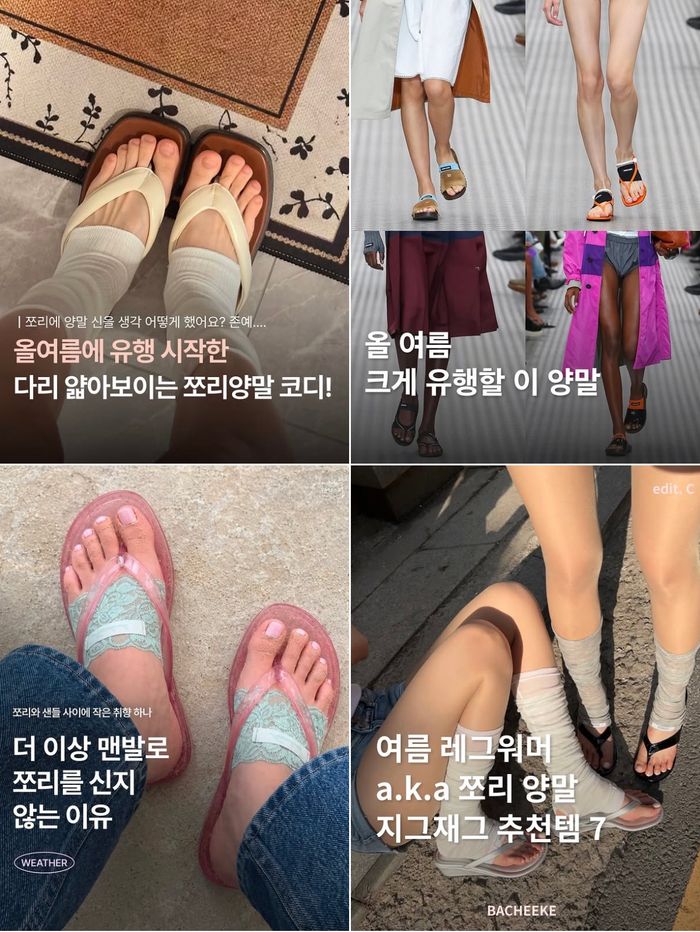
경제“쪼리에 양말을?” 고정관념 깬 스타일링에 매출도 껑충
국내 업계도 쪼리 출시 활발 2030 여성 공략한 플립플랍 매출 3.3배 늘어 오픈 토 삭스와 매치한 신박 스타일링 각광에 쪼리 덩달아 인기 오픈 토 삭스 스타일링 관련 SNS 바이럴. ⓒ인스타그램 바이럴 [데일리안 = 남가희 기자] 집 앞에서나 신던 쪼리 슬리퍼가 올여름 확실한 패션 아이템으로 자리 잡았다. 웨지 힐, 플랫폼, 키튼 힐 등 굽을 더한 다양한 디자인으로 확장되며 스타일링의 폭을 넓히고 있는 것이다. 아이돌 블랙핑크 제니는 쪼리 모티브의 웨지(통굽) 힐 샌들에 롱스커트와 재킷, 스카프를 매치한 스타일링으로 SNS상에서 화제를 모았다. 가수 강민경 또한 검정 홀터넥 톱과 베이지 쇼츠에 검정 웨지 힐 샌들을 매치했다. 발등을 드러내면서도 정제된 패션을 보여준 것이다. 디자인에 따라 무드도 달라진다. 두툼한 웨지 힐과 투박한 플랫폼 형태는 복고적인 향수와 현대적인 힙함을 동시에 담아낸다. 낮은 굽의 키튼 힐이 결합된 쪼리는 키치하고 페미닌한 무드를 연출하기 용이하다. 명품 하우스 브랜드 끌로에와 킴 카다시안의 스킴스는 캐주얼과 포멀을 오가는 키튼 힐 플립플롭을 선보였다. 국내 업계도 쪼리 출시 활발···2030 여성 공략한 플립플랍 매출 3.3배 늘어 셀럽과 럭셔리 하우스가 이끈 쪼리 열풍은 국내 패션 업계로도 이어지고 있다. 이랜드월드가 전개하는 캘리포니아 슈즈 라이프스타일 브랜드 오찌(OTZ)는 올해 다채로운 실루엣과 컬러의 쪼리(플립플랍)를 선보이며 시장 공략에 나섰다. 최근 한 달 기준 7월 13일부터 8월 12일까지, 오찌의 플립플랍 상품군 매출은 전년동기대비 226% 증가했다. 최근 두 달 기준 6월 13일부터 8월 12일까지, 오찌의 플립플랍 상품군 매출은 전년동기대비 198% 증가했다. 오찌는 올해 키높이가 가능한 두꺼운 미드솔을 적용한 '비들 플랫폼 플립플랍'과 미드솔이 얇고 날렵한 실루엣의 '코브스 플립플랍' 등 총 2가지 스타일을 선보였다. 코브스 플립플랍은 발 모양에 맞춘 풋베드에 적당한 높이의 아치 서포트를 더해 장시간 착용에도 안정적인 착화감을 갖췄다. 이 외에도 국내 패션 브랜드들의 반응이 뜨겁다. LF의 영 캐주얼 브랜드 질바이질스튜어트 역시 지난 4월 브랜드 최초로 통굽 형태의 플립플랍을 출시했고, 여성복 브랜드 아떼 바네사브루노는 기본 플립플랍에 힐 디자인을 접목한 신제품을 선보이며 쪼리 상품군을 확대했다고 밝히기도 했다. 패션 플랫폼에서도 관련 거래액이 가파르게 늘고 있다. 여성 패션 플랫폼 W컨셉에 따르면 지난 6월 1일부터 18일까지 플립플롭 카테고리 매출은 전년 동기 대비 110% 뛰었으며, 같은 기간 에이블리에서도 관련 거래액이 55%, 쪼리 거래액이 41% 증가했다. 29CM에서는 같은 기간 '힐 쪼리', '웨지힐 쪼리' 관련 거래액이 전년보다 3배 이상 증가했고, 지그재그에서는 '웨지힐 쪼리' 거래액이 401% 급증했다. 이랜드 오찌, '비들 플랫폼 플립플랍'. ⓒ이랜드 오픈 토 삭스와 매치한 신박 스타일링 각광에 쪼리 덩달아 인기 한편, 쪼리에 양말을 더하는 스타일링이 새로운 트렌드로 부상하며, 쪼리에 대한 관심도는 더욱 높아지고 있는 추세다. 정식 명칭은 '오픈 토 삭스(Open-Toe Socks)' 또는 '토리스 삭스(Toeless Socks)'로, 발가락은 드러내고 발등은 덮는 형태에서 이름이 붙었다. 소재는 면부터 니트, 레이스까지 다양하고 형태도 발등만 덮는 짧은 길이부터 발목 위를 덮는 긴 길이, 엄지발가락을 분리한 다비 형태까지 여러 가지다. 이 트렌드를 시작한 브랜드는 미우미우(Miu Miu)다. 2025년 봄·여름 컬렉션에서 종아리까지 올라오는 긴 양말부터 발등만 가리는 형태까지 다양한 오픈 토 삭스를 슬라이드, 플립플랍은 물론 하이힐에도 매치해 선보였다. 이후 여타 브랜드, 크리에이터가 잇달아 차용하고, 대중화를 이끌며 오픈 토 삭스는 올해 여름 스타일링으로 자리 잡았다. 조리 양말이 등장한 배경에는 기능적인 이유도 있다. 여름철 맨발로 조리 슬리퍼를 신을 때 발등 피부가 쓸리는 것을 방지하는데 탁월하다. 이랜드 오찌 관계자는 “여러 아이템을 겹쳐 입는 레이어드 스타일링이 큰 인기인 가운데, 상의·하의 뿐만 아니라 신발 영역에서도 레이어드가 활발히 이뤄지고 있다”고 말하며 “쪼리를 맨발에만 신어야한다는 고정관념을 탈피하고, 양말, 참 악세서리 등과 레이어드해 심미성과 실용성을 모두 잡는 패션이 최근 젊은 세대 중심으로 확산되고 있다”고 말했다
인스타그램시장 공략크리에이터SNSESS -
새 소식
xberg - 다국어 문서 인텔리전스 프레임워크
xberg는 PDF, 이미지, 오디오, URL 등 다양한 포맷의 문서를 단일 코어로 처리하여 텍스트, 표, 구조화된 데이터 등으로 변환해주는 다국어 문서 인텔리전스 프레임워크입니다. OCR, 웹 크롤링, 음성 전사, 코드 분석 및 LLM 연동 등 다양한 기능을 지원하며 라이브러리, CLI, REST API 등 여러 방식으로 배포할 수 있습니다.
PERESSAPICLILLM -
 세계
세계K-pop idols are finding their own voices via solo careers
Idols are pursuing solo careers to define artistic identities beyond their groups As K-pop’s summer release season continues, another trend has emerged alongside the industry’s biggest group releases: more established group members are stepping back into the spotlight as solo artists. From Apink’s Jung Eun-ji, Day6’s Young K and Oh My Girl’s Mimi, as well as Shinee’s Taemin and Minho and Exo’s D.O., a growing number of established idols are using solo projects to showcase artistic identities that differ from the images they have cultivated within their groups. Jung Eun-ji (Billions) Among such artists, some are taking greater creative control by writing and producing their own music. A strong example of this is Jung, who returned Tuesday with her fifth EP, “Summer, I,” nearly four years after her previous solo release. She participated in writing the lyrics for six of its seven songs while composing five and overseeing the album’s production. During a listening session held ahead of the album’s release, Jung said that producing the album gave her greater confidence as a singer-songwriter. “I’ve gradually become more confident in songwriting, thanks to this album,” she said. “I’ve already achieved many of the dreams I had as a child, and now I’m realizing my dream of becoming a singer-songwriter as well. This album brings me so much joy because of that.” Young K (JYP Entertainment) Day6’s Young K has taken an equally hands-on approach. His second LP “Youngest,” released in late July, credits the singer with writing, composing and producing all 15 tracks, spanning rock, pop, jazz, country, house and ballad influences. It is his first solo LP in nearly three years. Speaking in a behind-the-scenes documentary released on YouTube, Young K said that he “wanted listeners to be surprised by the breadth of genres explored throughout the album.” Mimi (RBW, DSP Media) Oh My Girl’s Mimi is also preparing to make her solo debut after more than a decade with the group. She produced her upcoming single, “Bish Bash Bosh,” scheduled for release on Aug. 20, and participated in writing and composing the music. According to DSP Media, the project is intended to introduce “the real Mimi” by reflecting a musical identity that stretches beyond what she created as an Oh My Girl’s member. Not every solo comeback, however, is centered on songwriting. Shinee’s Taemin is set to open a new chapter in his solo career with “Phase 1: Soft Violence,” due Aug. 21. The album introduces an entirely new narrative universe through surreal visual storytelling and will be followed by his upcoming world tour, “Liminal.” Exo’s D.O. is also preparing his first solo release in about a year, slated for August, while Shinee’s Minho is likewise expected to return with his second EP in early September. Taemin (Galaxy Corporation) For many idols, solo projects have become an opportunity to reveal artistic sides that may not fit within their group’s established musical identity. “Many idols inevitably adapt themselves to a group’s musical framework,” music critic Lim Hee-yun told The Korea Herald. “Solo activities give them an opportunity to step outside that framework and express styles or stories that couldn’t easily be shown through the group.” Lim added that idols who write, compose and produce their own music “not only showcase a broader musical spectrum but also establish themselves as creators rather than mere performers.” "Fans enjoy discovering what the artists themselves want to express through music, and that often creates a deeper emotional connection," Lim said. "Sometimes self-written songs reveal fresh perspectives that even experienced producers wouldn't have imagined, making this a very welcomed trend in K-pop."
youtubePERESSICEWHO -
 세계
세계North Korea resumes long-delayed naval base construction amid fleet modernization
A naval gun aboard North Korea’s new 5,000-ton-class destroyer Kang Kon is test-fired during a demonstration observed by North Korean leader Kim Jong-un on July 3. (KCNA via Yonhap) North Korea appears to have resumed construction of a long-delayed naval base on its east coast, as Pyongyang accelerates efforts to modernize its fleet with new destroyers and a nuclear-powered submarine. New structures, believed to be temporary housing or tents for construction workers, appeared between Aug. 6-9 at the Tapchon Bay naval base site in Munchon, in North Korea's Kangwon Province, according to an analysis of Planet Labs satellite imagery by NK News. The outlet said the structures could accommodate personnel expected to work on planned administrative and training facilities, suggesting that construction at the site has resumed after years of little visible activity. Construction has also been observed around the base. A new road and small bridge have been under construction since mid-May near Sokchon Bay west of Tapchon Bay, while road construction and land-clearing work began last month on a peninsula south of the base, according to the report. NK News said the activity could indicate that North Korea seeks to expand the facility's size and functions beyond its original plans. White structures or tents believed to be for conscripted construction workers are seen at the naval base project site in early August. The graphic was created by NK News senior analytical correspondent Colin Zwirko using satellite imagery from Planet Labs. (Courtesy of NK Pro and Planet Labs) The Munchon base has been under development for more than a decade. North Korea built more than 10 piers and docking facilities capable of accommodating large warships and submarines between 2015 and 2017. A railway bridge connecting the base to the national rail network was completed in 2018, but construction largely stalled afterward. North Korean leader Kim Jong-un visited the unfinished site in September 2024 and called completion of the base an “urgent task.” The renewed construction comes as North Korea rapidly expands its naval capabilities. Pyongyang has unveiled two new 5,000-ton-class destroyers, the Choe Hyon and Kang Kon, and has been conducting weapons and navigation tests involving the vessels. The North is also pursuing a nuclear-powered submarine program, while Kim in June ordered the construction of a 10,000-ton-class cruiser. But infrastructure for the new vessels has lagged behind. The Choe Hyon, commissioned in June, has remained at the civilian cargo port of Nampo on the west coast, while the Kang Kon has been seen operating from Rason on the east coast after completing a series of sea and missile tests. Kim acknowledged the shortage during the Choe Hyon commissioning ceremony in June, saying North Korea lacked bases capable of accommodating large warships such as destroyers. The renewed work at Munchon could therefore provide a permanent base for the North’s new destroyers and future nuclear-powered submarines while expanding the operational reach of its east coast fleet. Kim has also called for the Navy to develop into a force capable of regularly operating beyond North Korea’s territorial waters. Kim Jong-un (center) and senior officials observe tests of key weapons systems, including missiles and naval guns, aboard the new 5,000-ton-class destroyer Kang Kon on July 3. (Korean Central Television via Yonhap) Ballistic missile launch Separately, North Korea fired a ballistic missile into the East Sea on Wednesday, South Korea’s Joint Chiefs of Staff said. The military said it detected the launch at around 6 a.m., but did not immediately disclose the location. The missile flew about 700 kilometers, the military said without disclosing the altitude reached. “Our military has strengthened surveillance and vigilance against possible additional launches, while South Korea, the United States and Japan are closely sharing information on the North Korean ballistic missile and maintaining a full readiness posture,” the JCS said. The launch came two days after South Korea and the United States announced plans to conduct their annual Ulchi Freedom Shield exercise from Aug. 17-27. North Korea has long denounced major South Korea-US military exercises as rehearsals for an invasion and has often responded with missile launches and other military activities. Wednesday’s launch came six days after North Korea fired short-range ballistic missiles into the East Sea from the Wonsan area on Aug. 6. It marked North Korea’s 11th ballistic missile launch event this year.
PERESSCIAIMAAPI -
 세계
세계Samsung, SK hynix chip clusters get new power supply road map
Honam complex to receive initial 3 GW for 2029 fab operations; Yongin clusters to require over 14 GW by 2041 KEPCO President and CEO Kim Dong-cheol speaks during the signing ceremony Wednesday. (KEPCO) South Korea laid out a new power supply road map Wednesday for planned semiconductor clusters involving Samsung Electronics and SK hynix, as the government seeks to ensure electricity shortages do not delay the scheme. The southwestern Honam semiconductor complex will initially receive about 3 gigawatts of power to support the start of fab operations in 2029, with capacity later expanding to more than 6 GW, according to the Ministry of Climate, Energy and Environment. Two semiconductor complexes in Yongin, Gyeonggi Province, are expected to require more than 14 GW by 2041, with electricity to be supplied in phases as new transmission lines and power generation facilities come online. The government, Jeonnam-Gwangju Special Metropolitan City, Samsung Electronics, SK hynix and state-run Korea Electric Power Corp. signed three agreements Wednesday covering power supplies for the Honam and Yongin projects. “The key to the success of the semiconductor megaprojects is ensuring a swift power supply,” Climate Minister Kim Sung-hwan said in a statement. “The government, businesses and local authorities will work as one team to drastically shorten administrative procedures and ensure electricity is supplied in time for the construction of the new industrial complexes.” The Honam complex, announced June 29 as part of the government’s push to establish a major semiconductor production base outside the Seoul metropolitan area, is expected to eventually require more than 6 GW of electricity. Power infrastructure capable of supplying about 3 GW will be built first to allow initial fabs to begin operations in 2029, with additional facilities to raise capacity above 6 GW as the complex expands. In Yongin, the government plans to use nearby transmission lines and three 1-GW liquefied natural gas power plants to provide initial electricity to the national semiconductor complex, which is planned to house six fabs. The approach is intended to secure power before longer-distance transmission infrastructure is completed, amid difficulties in building new transmission lines. The separate Yongin general industrial complex began receiving electricity in July through a new line connecting the Sinanseong and Dongyongin substations. Additional transmission lines are planned for 2031 and 2032.
Samsung ElectronicsSWIFTPERESSCIA -
 세계
세계Lee vows full backing for 7 future industries to drive next wave of growth
President Lee Jae Myung (center) listens to a policy presentation by Deputy Prime Minister and Science and ICT Minister Bae Kyung-hoon during a briefing on the government's "seven seed technologies for future growth" initiative at Cheong Wa Dae on Wednesday. (Yonhap) President Lee Jae Myung on Wednesday pledged full government support for seven advanced technologies, describing them as the country's next "mega projects" that will drive economic growth and strengthen national competitiveness in the artificial intelligence era. Speaking at a briefing on the government's "seven seed technologies for future growth" initiative at Cheong Wa Dae, Lee said the technologies would become both the country's next growth engines and core strategic national assets. "The seeds of advanced technologies we plant today will one day grow into giant trees and become new mega projects," Lee said. The meeting brought together around 60 government officials, researchers, entrepreneurs, venture capital investors and science and engineering students to discuss ways to foster seven strategic industries identified by the presidential office as key assets for South Korea's economy and national security. The seven "seed technologies" are small modular reactors, nuclear fusion, renewable energy, quantum technology, aerospace, advanced biotechnology, and supply chains for critical minerals, materials, parts and equipment. The initiative is designed to build the next generation of growth industries beyond the government's existing three mega projects centered on semiconductors, artificial intelligence and AI data centers. The presidential office said the meeting sought ways to support South Korea's AI transformation while securing and nurturing advanced technologies that will underpin the country's next phase of economic growth. The government plans to group the seven sectors into three strategic pillars: future clean energy, consisting of SMRs, nuclear fusion and renewable energy; next-generation frontiers, comprising quantum technology, aerospace and advanced biotechnology; and advanced supply chains for critical minerals, materials, parts and equipment. It also unveiled sector-specific road maps. The government aims to commercialize light-water SMRs by 2035 while beginning construction of non-light-water SMRs during the 2030s. It plans to generate electricity through nuclear fusion by the late 2030s, develop a domestically produced 100-qubit quantum processor by 2029, launch a privately led lunar lander by 2030 and establish an independent low-Earth-orbit satellite communications network by 2035. It also aims to commercialize brain-computer interface technology by 2035. A central pillar of the initiative is public-private collaboration. For capital-intensive technologies such as non-light-water SMRs, fusion reactors, quantum chip foundries and gene and cell therapies, the government plans to establish jointly funded special purpose companies to support projects from research and development through commercialization, demonstration and regulatory reform. The strategy also includes measures to overhaul South Korea's research ecosystem. Universities will receive block funding to support large-scale, long-term research, while government-funded research institutes will be transformed into organizations responsible for long-term national missions following the planned abolition of the Project-Based System. To oversee implementation, the government will launch a public-private task force, headed by Deputy Prime Minister and Science and ICT Minister Bae Kyung-hoon, to coordinate the development of the "seven seed" technologies. Progress on sector-specific road maps will be reviewed regularly through ministerial meetings on science and technology policy. Lee said the rapid pace of technological change makes it increasingly difficult to predict which industries will emerge as growth drivers. "One common characteristic of cutting-edge technologies attracting attention today is that technological replacement cycles are becoming extremely fast," he said. "Individuals and countries alike will be left behind if they fail to keep up with change." Pointing to semiconductors as an example, Lee said the industry had entered what he described as a structural boom after recently facing concerns over a prolonged downturn. "We are living in an era of great transformation, where it is extremely difficult to predict which advanced technologies will emerge in the coming years or how the industrial landscape will change," he said. Lee stressed that South Korea must capitalize on its strengths in semiconductors to prepare for the next stage of growth driven by AI. "It is up to us whether we become a leader that enjoys limitless opportunities or a follower constantly exposed to the risk of being left behind," he said. "We must take advantage of the tremendous opportunity created by the semiconductor industry and prepare in advance for the next growth engine in the era of artificial intelligence." Calling on researchers and innovators to lead the country's technological transformation, Lee urged participants to help South Korea evolve beyond being a semiconductor powerhouse into a global leader in advanced science, technology and talent. "The government will provide firm support so that our innovative companies and scientists can freely pioneer new markets and boldly take on new challenges," he said. Bae said he would personally oversee implementation of the initiative as head of the new task force. "The mega projects and the seven seed projects will serve as twin engines that work independently and together to build an irreplaceable South Korea," he said.
supply chainReactPERESSCIA -
 세계
세계Ahn Ha-young debate: Why does a Korean actor’s family history still matter?
The controversy reveals how sensitive Korea remains about its colonial past — and why public figures should know better, experts say Ahn Ha-young poses for a photo during a press conference held in Seoul, Aug. 5 (Netflix) Ahn Ha-young’s rising career has hit a major roadblock after comments about her family history sparked backlash over allegations that her great-grandfather was linked to Japan’s colonial rule of Korea, just days before Liberation Day on Aug. 15. The uproar has revived the debate over whether descendants should be held accountable for their ancestors’ actions — with experts stating the Korean public increasingly places more weight on how descendants conduct themselves today than on their lineage alone. The issue at hand emerged during Ahn’s promotional campaign for "Our Sticky Love," Netflix Korea’s highly anticipated romantic comedy, which premiered globally last week. Ahn, who made her acting debut in 2019, has spent much of her career in supporting roles, appearing in projects including the hit series "The Trauma Code: Heroes on Call" and "Doona!" "Our Sticky Love" marks one of her first major leading projects. At a time when Ahn was gaining prominence, her mentions of her family background on several television programs resurfaced, with one of the most recent examples being her Aug. 7 appearance on KBS’ variety show "Problem Child in House." During the show, Ahn said her great-grandfather had opened a Western-style clinic in Hanyang (Seoul's former name) and treated Emperor Gojong. She added that h er grandfather, father and older sister are doctors, making hers a four-generation family of doctors. Although Ahn did not identify her great-grandfather by name during the broadcast, online speculation soon pointed to Ahn Sang-ho, a doctor who practiced during Japan’s colonial rule of Korea. The great-grandfather Attention quickly turned to Ahn Sang-ho’s activities during the colonial period, particularly his involvement with the Daejeong Friendship Association. Founded in 1916 as a business organization, the group was led by Min Yeong-gi, a known pro-Japanese collaborator, and included several figures associated with Japan’s colonial government. Among them was Yi Wan-yong, one of the signatories of both the 1905 Eulsa Treaty and the 1910 Japan-Korea Annexation Treaty, which formally placed Korea under Japanese rule. The allegations triggered immediate backlash against Ahn. Her agency, Bistus Entertainment, initially dismissed claims that Ahn Sang-ho was a pro-Japanese collaborator on Monday but reversed course the following day. Further verification had confirmed historical records identifying Ahn Sang-ho, the actor's great-grandfather, as a council member of the Daejeong Friendship Association. The agency apologized for issuing its initial statement before sufficiently verifying the information. Press interviews with Ahn and her co-star, Jung Hae-in, were subsequently canceled, dealing a setback to the drama’s global promotional campaign as well as her multi-million dollar commercial ad opportunities. As the controversy intensified, Ahn issued a public apology Wednesday, saying she had been unaware of her ancestor’s past. "Our Sticky Love," starring Ahn Ha-young (Netflix) According to experts, the intensity of the backlash may hinge not simply on the existence of the historical record, but on how Ahn’s great-grandfather’s role during the colonial period is interpreted. “There were different degrees of collaboration with Japan during the colonial period,” said Lee Sung-min, an associate professor in the Department of Media Arts and Sciences at Korea National Open University. While some figures may technically be categorized as pro-Japanese despite having had limited choices under colonial rule, Lee said others actively cooperated with the colonial authorities. “Ahn’s great-grandfather appears to fall closer to the latter category,” Lee said. Historic sensitivity But experts add the more fundamental issue may not be Ahn’s ancestry itself, but how she presented her family history. “People would be more uncomfortable not with the fact itself, but with how the descendants conduct themselves,” said pop culture critic Jung Duk-hyun, pointing to cases in which descendants distort the past or speak about their ancestors’ actions with pride. “Even if someone is a descendant, if they have a negative view of their ancestor’s actions, they’re unlikely to go around highlighting or taking pride in that connection. They can instead take a more humble stance or show greater interest in and engagement with those historical issues. I don’t think the (Korean) public would necessarily criticize them if they responded in those kinds of ways,” Jung said. "Our Sticky Love," starring Ahn Ha-young (Netflix) The controversy arrives at a particularly notable moment in Korea-Japan relations, as cultural exchange between the two countries has entered a high point in relations. According to Hankook Research, Japan’s favorability rating among South Koreans stood at 44.8 degrees in a July 2026 survey, up from 42.7 degrees in April and 44.6 degrees in January. It was the highest rating recorded since the firm began measuring favorability toward the countries surrounding Korea — China, Japan, North Korea, Russia and the US — in 2018. The survey uses what it calls a “feeling thermometer” ranging from 0 degrees, meaning very unfavorable, to 100 degrees, meaning very favorable. However, experts stress that Koreans maintain a boundary between contemporary lifestyle trends and historical accountability. "Cultural exchange and consuming each other’s cultural content is essentially a matter of personal taste," Jung said, noting that audiences separate entertainment choices from unresolved colonial grievances. Ahn Ha-young speaks during a press conference held in Seoul, Aug. 5 (Yonhap) That growing separation between Japanese culture and the country’s colonial past, however, does not necessarily apply to the descendants of those who collaborated with Japan. “Obviously, (descendants of pro-Japanese collaborators) are not going to be viewed favorably. But I do think some of these tensions are gradually being resolved,” Lee said, adding that since anti-Japanese sentiment has been passed down across generations, there is also a growing degree of nuance and rationality in how some Koreans approach the issue. "If someone can clearly distinguish between the two by saying, 'What my parent did was wrong, but I am a different person,' then people can see that person as someone who shares the same basic values," Lee said. "But in this case, that distinction wasn’t really made. There seemed to be a lack of awareness of what was wrong in the first place."
NetflixDRAMPERESSCIA -
 사회
사회Ha Young apologizes over great-grandfather’s colonial-era record in handwritten letter
The actor said she had unknowingly treated her great-grandfather’s history as family pride before learning of his pro-Japanese activities. Left: Actor Ha Young at a press conference for the Netflix series "Our Sticky Love" at Hotel Naru Seoul MGallery in Mapo District, western Seoul, on Aug. 5.Right: The actor's apology letter posted on Instagram on Aug. 12. NEWS1, SCREEN CAPTURE Ha Young apologized Wednesday in a handwritten letter for speaking publicly about her great-grandfather as a point of family pride. The actor said she had done so without knowing the great-grandfather's record under Japanese colonial rule. "First, I bow my head in apology for the great disappointment and hurt caused by matters concerning my great-grandfather," the actor said in a handwritten letter, posted to her Instagram account on Wednesday. This is Ha Young's first statement in her own words since the controversy began. Ha Young, best known for her role in the Netflix Series "The Trauma Code: Heroes on Call" (2025) and Netflix rom-com "Our Sticky Love," appeared on the KBS show "Problem Child in House" (2018–) on Friday and described the four generations of doctors in her family. Her great-grandfather studied Western medicine in Japan, opened one of the first Western clinics in Seoul and treated Emperor Gojong (1852-1919), the actor said herself on the program. Viewers identified him as An Sang-ho and shared records of his actions under Japanese colonial rule as a collaborator. "Until now, I knew my great-grandfather's life only in fragments, from stories passed down through my family," she wrote. "Shamefully, in that ignorant state, I brought up stories about my great-grandfather in various settings as if they were a source of my family pride." Ha Young's agency, Bistus Entertainment, first denied such allegations on Monday, only to confirm An's record as a member of the Daejeong Chinmokhoe, a pro-Japanese organization, on Tuesday. Actor Ha Young poses at a press conference for the Netflix series "Our Sticky Love" at Hotel Naru Seoul MGallery in Mapo District, western Seoul, on Aug. 5. NEWS1 "I also consider it my own failing that a mistaken position was conveyed without sufficient checking," she wrote. "I sincerely apologize for the greater confusion and hurt this caused." The actor said her statement came late as she had hesitated over how to express her apology. She also fully admitted the responsibility as a descendant. "I do not think the fact that I did not know can be a reason to look away from that history or to treat it lightly," she wrote. "I accept it with a heavy heart and apologize sincerely as a descendant." "It weighs on me all the more that my shortcomings have caused concern at a time just before Liberation Day." Korea's Liberation Day falls on Aug. 15, a Saturday. The actor also pledged to study her family's history and the colonial period and to show respect for the independence activists and others who worked for Korea's liberation. "I will act on this, not just speak of it," she wrote. A press interview for "Our Sticky Love" scheduled for Friday was also canceled on Tuesday.
NetflixPERESSWHOETF -
아직 공개된 뉴스가 없습니다.
새 기사가 준비되는 대로 이곳에 표시됩니다.