 Seodo Band poses for a photo before an interview with The Korea Herald in Seoul, Aug. 6. (Lee Sang-sub/The Korea Herald)
If there had been K-pop during the Joseon era, perhaps it would have sounded something like Seodo Band.
Formed by five conservatory classmates, the band spent nine years circling around the material that would eventually become its first full-length album, "One: Circle," set for release Friday.
The band — vocalist Seodo, guitarist Yeon Tae-hee, bassist Kim Tea-joo, drummer Jeong Hyun-bin and keyboardist Kim Seong-hyun — calls its music "Joseon-pop," a genre of its own making that combines traditional Korean musical elements from gukak with contemporary pop songwriting. Nearly a decade after coining the term, the band still largely occupies that territory alone.
The band's beginnings were considerably less deliberate. Four labelmates entered the “21c Korean Music Project” competition in 2018 and formed a band because the contest required them to perform as a group.
"We didn't originally plan to make band music," Seodo said during an interview with The Korea Herald on Aug. 6. "But going into that competition, we had to form a group — and that thought carried us all the way to now."
The idea of making a full album came much later.
"I never really thought about releasing a full album while we were doing this as a band. But if we ever did one, I thought it should be the 'Chunhyangga' set that was the start of our activities as Seodo Band. Now, nine years in, I strongly felt it might finally be time, and that pushed us to move forward," bassist Kim said.
"Chunhyangga," or "The Song of Chunhyang," is one of the best-known works of pansori, the traditional Korean form of musical storytelling performed through singing and narration. Seodo Band has been performing its own 30-minute interpretation of the story since its early days.
The result is a 12-track album structured more like a play than a collection of individual songs. Seven songs follow the narrative of "Chunhyangga" in sequence, from the lovers' meeting in "Arirang" and their vow in "Love Song" through separation, imprisonment and eventual reunion in the closing track, "As One."
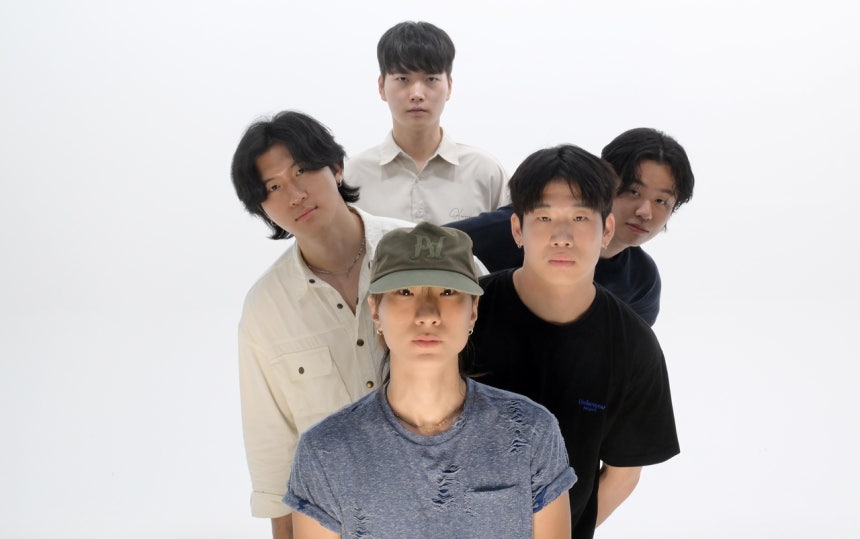 Seodo Band poses for a photo before an interview with The Korea Herald's building in Seoul, Aug. 6. (Lee Sang-sub/The Korea Herald)
Five short instrumental pieces connect those chapters, each built around a different instrument. Their titles contain the letters A, N, I, R and I, which together spell "aniri," the spoken narration used in pansori to connect sung passages and move the story forward.
"We wanted people to listen to the whole thing as one connected story," Yeon said. "When we perform the 'Chunhyangga' set live, there's no MC banter between songs. That narration bridges everything into one."
That sense of connection extends to "As One," the final song written for the album, and to the album's title itself. "One" means "circle" in Korean.
"This song holds the meaning of circulation that runs through the whole album," Seodo said. "There is no such thing as forever. Where there is meeting, there is parting. And where there is parting, there will be meeting again. That is the shape life keeps repeating."
The album begins, fittingly, with "Arirang," named after Korea's best-known folk song. The choice comes as BTS has also used "Arirang" as the title of its latest album, but Seodo Band said the familiarity of the name did not make the members hesitant.
"The Arirang most people know carries something more sorrowful, as you said. But the Arirang Seodo Band has always sung and played has always held warm emotions, so wanting to share that together came first — rather than feeling burdened," bassist Kim said.
For Seodo, the appeal of "Arirang" reaches beyond nationality.
"No matter which country's lullaby you hear, a lullaby feels like a lullaby. We all carry the same old feeling it stirs, because we are all human. I think Arirang holds that kind of power," he said.
That Korean identity runs throughout "One: Circle," although the band says it was not something the members consciously set out to emphasize. Almost all the album's lyrics and song titles are in Korean.
"There wasn't really a big intention behind it," Jeong said. "Looking at the whole album, the only English lyric is one word, 'You' in 'Love Song' — that's the one exception. It wasn't some deliberate decision to keep English out and only express Korean-ness. We just made and released what we had, and it turned out that way. If anything, I think that lets foreign listeners fall more into the charm of the Korean pronunciation and nuance itself."
 Seodo, the leader of Korean fusion group Seodo Band, performs during Africa Day 2026 at the Grand Hyatt in Seoul on May 20. (Lee Sang-sub/The Korea Herald)
There have already been unexpected signs of the band's music traveling abroad. Yeon recalled receiving a video from a university classmate on a working holiday in the UK who unexpectedly heard the band's earlier single "City Lights" playing at a London pub with no apparent connection to Korean culture. The band said its highest social media engagement currently comes from the US.
Yet even as Korean musical traditions underpin its sound, Seodo Band is reluctant to define itself as a traditional Korean music act.
A judging panel for the Rising Star of Korean Traditional Music award on national broadcaster KBS in 2019 described the band's approach as "the most ideal collaboration between traditional music and popular music." Seodo draws a firmer distinction.
"We say confidently that our music is not traditional music," he said. "Traditional music is music that inherits tradition. If our music has both inheritance and development, it's the developed form. That shouldn't be called traditional music. I studied pansori as a child, and I have real respect for it. Ours is just something more people can listen to easily."
If Joseon-pop eventually takes the band to a larger international stage, the members already know where they would like to go.
"I watched Coachella recently and it left a deep impression. If Seodo Band, carrying Korean sensibility, went there and put on a stage worthy of that, I think we could create something incredible," bassist Kim said.
And they already have an image of what that stage could look like: a crowd performing Ganggangsullae, a traditional Korean communal dance in which participants join hands to form a large circle.
"That's what we always talk about. The image of a Ganggangsullae circle made up of people who aren't even Korean," bassist Kim said.
 Seodo Band (Seodo Band)