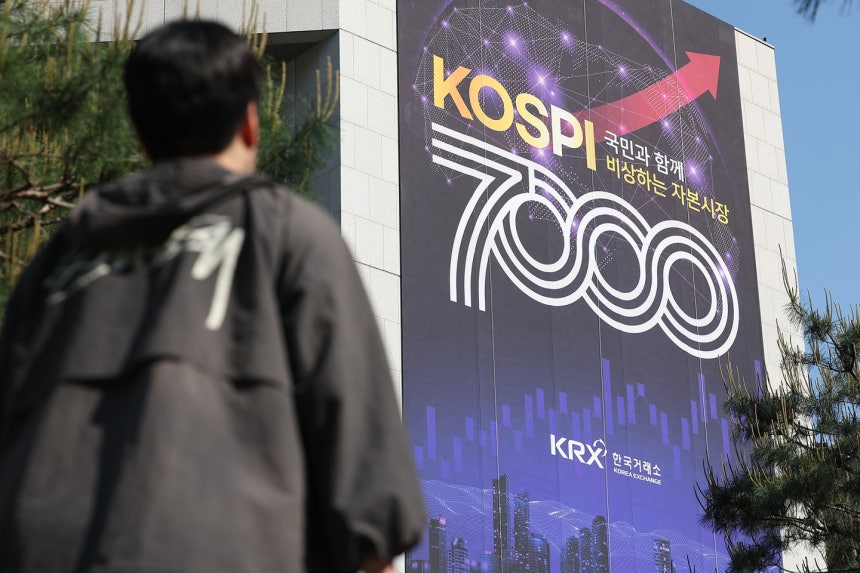
 A sign marking the Kospi’s close above the 7,000-point level for the first time is displayed on the exterior wall of the Korea Exchange’s Seoul office in Yeongdeungpo District, western Seoul, on May 6. YONHAP
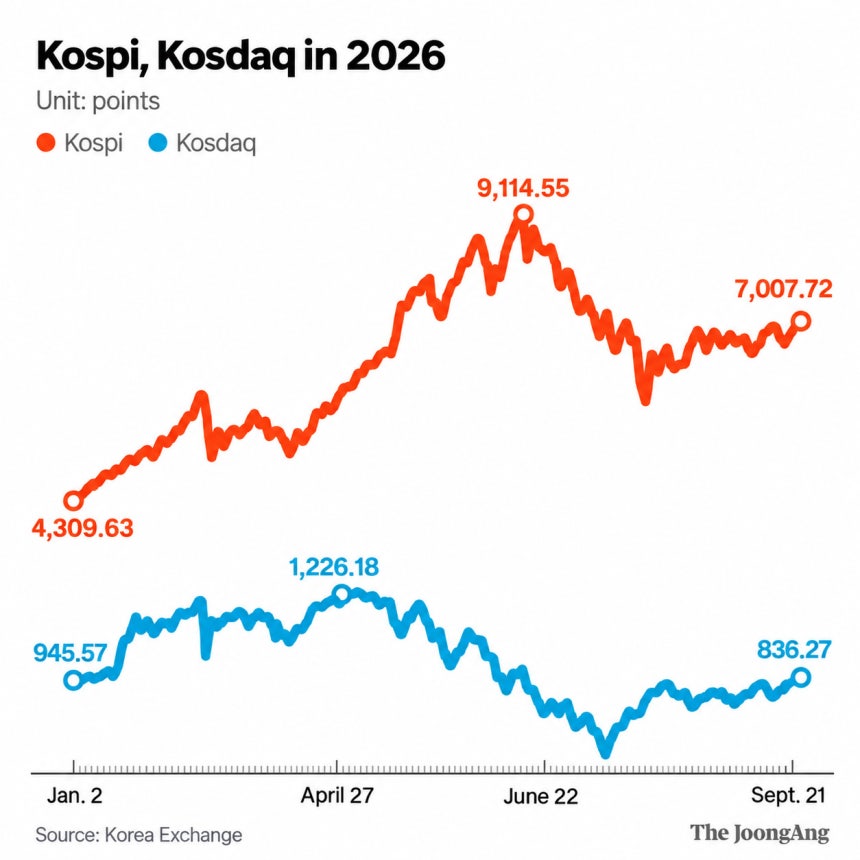
The Kospi was hovering slightly above the 7,000 mark ahead of the Chuseok holiday, rising above the threshold after weathering successive interest rate increases in Korea, the United States and Japan.
Investors are now hoping that the rally can continue after the holiday break, when the market resumes regular trading on Monday.
Historical data offers some encouragement. The Kospi rose on the final trading day before Chuseok in 73 percent of the 22 years from 2004 to 2025, according to an analysis by Daishin Securities released last Monday.
The gains often continued after the holiday period. The Kospi rose over the five trading days after the holiday in 68 percent of the years analyzed, with an average gain of 1.34 percent. In years when the Kospi fell before Chuseok, the index gained an average of 1.65 percent over the following five trading days.
Trading activity has shown a similar pattern. The Kospi’s five-day average trading value fell from 10.7 trillion won to 9.9 trillion won ($7.9 billion to $7.3 billion) before Chuseok over the past five years, then rose to 11.6 trillion won after the holiday, according to Korea Investment & Securities.
“Investors may become more risk-averse and reduce their positions ahead of a market closure [for the holidays],” Kim Dae-jun, a researcher at Korea Investment & Securities, said.
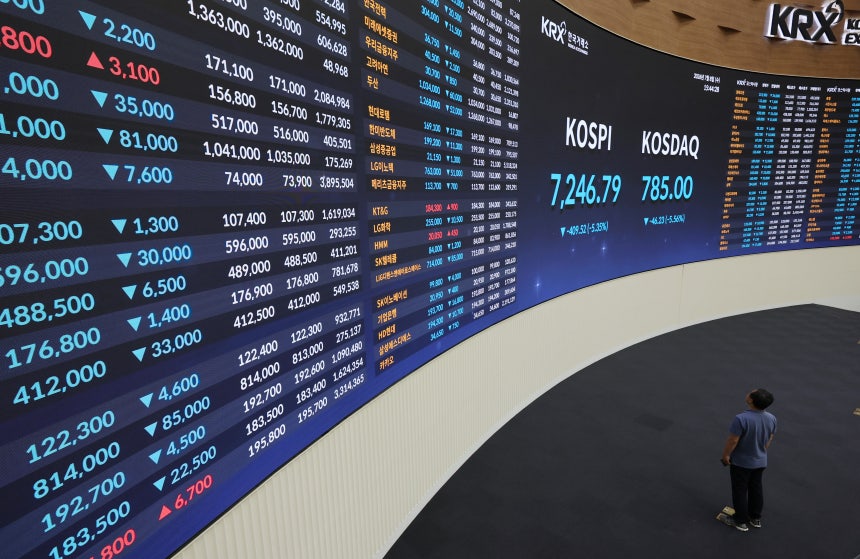 The Kospi, Kosdaq and individual stocks are displayed at the Korea Exchange in Yeouido, western Seoul, on July 8. YONHAP
A U.S.-China summit was held on Thursday, while the Korean stock market was closed for Chuseok. Key issues included extending the trade truce, lowering reciprocal tariffs, China’s rare-earth export restrictions and U.S. technology controls on China. The Korean market will price in the outcome when regular trading resumes on Monday.
Oil prices and U.S. Treasury yields are also major risks. The Kospi fell to the 6,600 range earlier in the month after international oil prices rose above $100 a barrel and the yield on the 10-year U.S. Treasury climbed above 5 percent.
“Whether the Kospi can break through the 6,900 to 7,100 range and stay there will determine whether the rally has further to run,” Lee Kyung-min, a researcher at Daishin Securities, said. “The 60-day and 120-day moving averages both fall within that range. If the semiconductor and AI momentum combines with expectations for the U.S.-China summit, the Kospi could push into the 7,500 to 7,700 range.”
Foreign buying will be another key factor.
 The logo of Samsung Electronics is seen at the company's store in Seoul on April 15, 2025. REUTERS/YONHAP
Foreign investors bought a net 400 billion won worth of shares on the main bourse on Sept. 18, the first net buying session by foreign investors in eight trading days. Most of the buying focused on major semiconductor stocks such as Samsung Electronics and SK hynix.
“The weakest link in the recent market was the absence of a clear net buyer because of macroeconomic uncertainty,” Lee Jae-won, a researcher at Yuanta Securities Korea, said. “If macroeconomic uncertainty eases, foreign investors could return as net buyers.”
Semiconductor earnings will be even more important because chip stocks have been driving the Korean market.
U.S. chipmaker Micron Technology is scheduled to report earnings on Wednesday, after the Chuseok holiday. Samsung Electronics is expected to release preliminary earnings in early October.
 The Micron logo is shown in this graphic from June 11. REUTERS/YONHAP
Recent developments in the U.S. market have also pointed to stronger real demand for AI infrastructure. GPU rental prices have risen, AI accelerator prices have increased and data center investment has expanded.
“Competition over AI investment is spreading beyond GPUs and memory chips to infrastructure such as power, servers and optical communications,” Lee said. “The investment push is bipartisan and largely unrelated to the outcome of the U.S. midterm elections.”
The Kosdaq has a weaker seasonal record after Chuseok.
The tech-heavy secondary bourse outperformed the Kospi between Chuseok and the end of the year only five times since 2005, according to SK Securities. The biggest gaps came in 2005, when the Kosdaq beat the Kospi by 13 percentage points, in 2011 by 5.5 percentage points and in 2017 by 19.3 percentage points.
The three years had several things in common: weak momentum among large-cap stocks, strong themes among major Kosdaq companies and net buying by foreign and institutional investors.
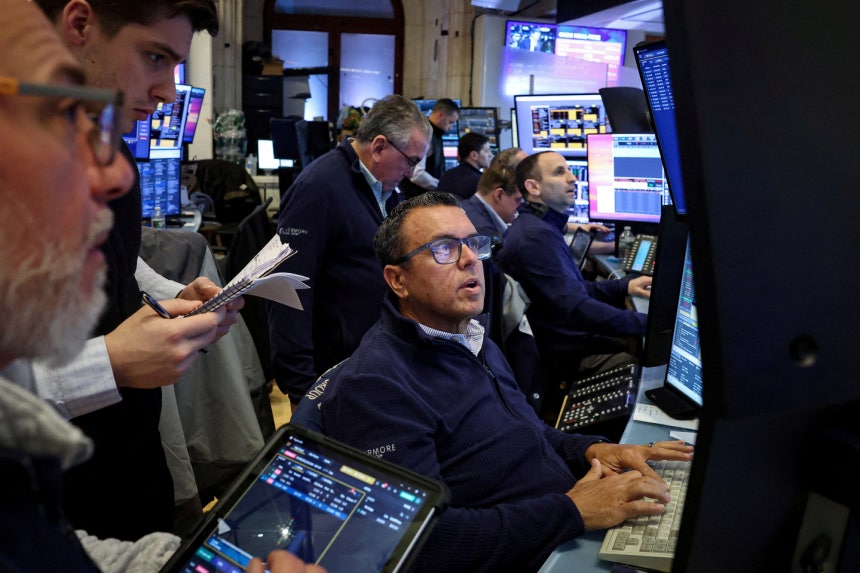 Traders work on the floor at the New York Stock Exchange in New York on March 2. REUTERS/YONHAP
“Toward the end of the year, investor attention often shifts to high-dividend large-cap stocks and Kospi-listed companies because of dividends and year-end window dressing by institutional investors,” Na Seung-doo, an analyst at SK Securities, said. “The Kosdaq tends to show a stronger seasonal advantage in January than at the end of the year.”
Still, this year may not follow the usual seasonal pattern.
“Government measures to support the Kosdaq could create conditions for institutional net buying,” Na added. “Investors should closely watch corporate earnings and policy developments after Chuseok.”