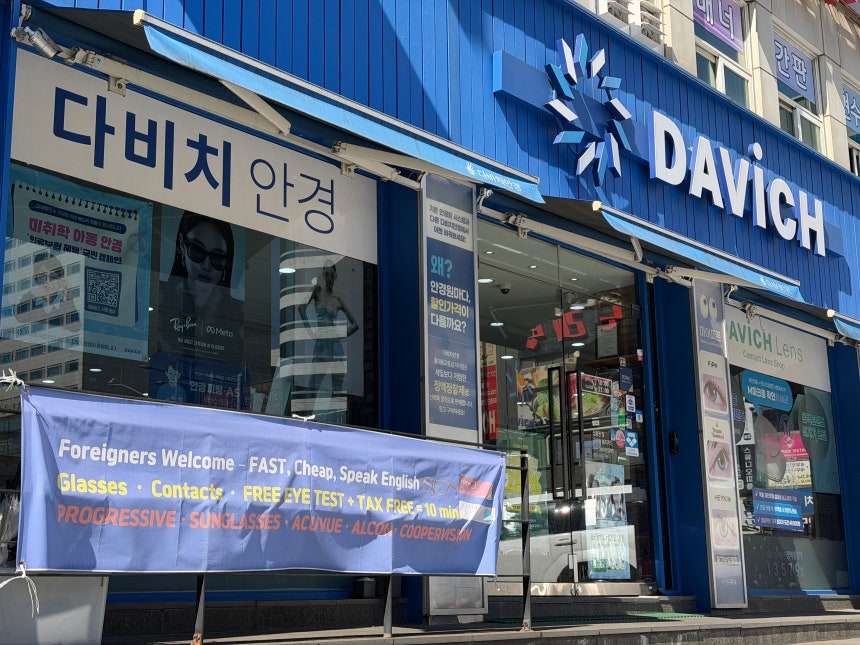
 A placard advertising that foreigners are welcome and that staff speak English hangs in front of a Davich Optical branch in Hongdae, western Seoul, on Oct. 8. LEE TAE-HEE
What can you do in 30 minutes? Grab a coffee, have a quick lunch or run an errand or two. But in Korea, you can also get a new pair of prescription glasses.
"The eye exam was very fast, and I think it took five minutes," Lauren from the United States said, while wearing the clear acetate frames she got from an optical shop in Myeongdong, central Seoul, on Oct. 6. "We also spent time picking the frame, and we were here for about 15 to 20 minutes total."
She got glasses with her friend Cynthia, who recommended the visit after hearing that Korea was known for fast, high-quality glasses. While the process takes minutes in Korea, it would have taken weeks back in the United States.
"It depends on the brand and things like that, but for me, I need high prescription glasses and it normally takes around two weeks," Lauren added.
Daisy, from Germany, also got a pair of glasses at another optical shop in Myeongdong that day. For her, price was another perk of getting glasses in Korea.
"If you have an astigmatism, you can even pay up to a thousand euros [1.5 million won] for a pair of glasses," Daisy added. "I've seen a lot of Instagrammers say that Korean glasses are really good, fast and that you can get them cheaper. It's still not cheap here, but it's one-third the price I would pay in Germany."
The speed has turned glasses into a must-buy item for many tourists, but how does Korea do it so fast?
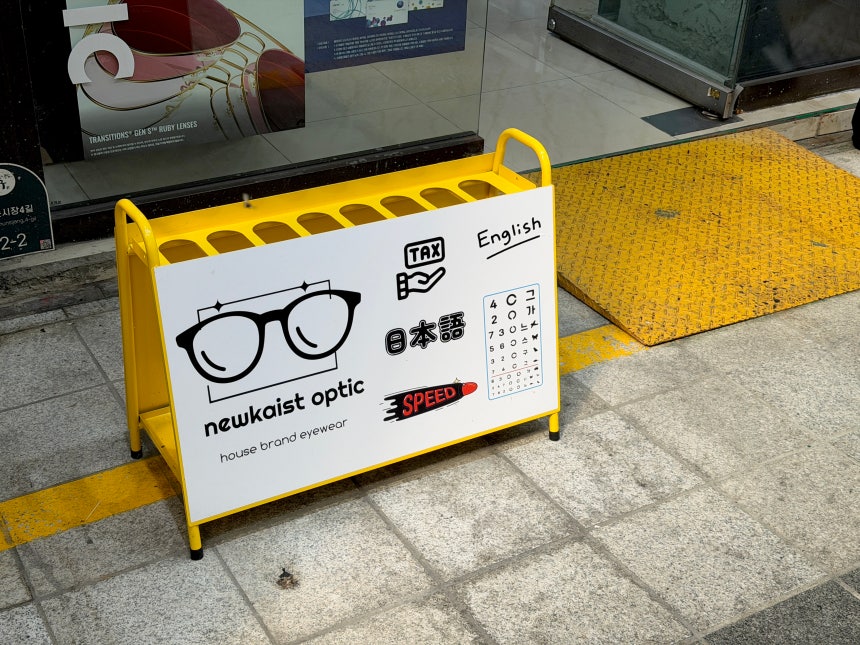 A sign in front of an optical shop in Namdaemun Market, central Seoul, advertises that glasses can be made quick, and that Japanese and English consultations are available, on Oct. 8. LEE TAE-HEE
Q. How popular is getting glasses in Korea?
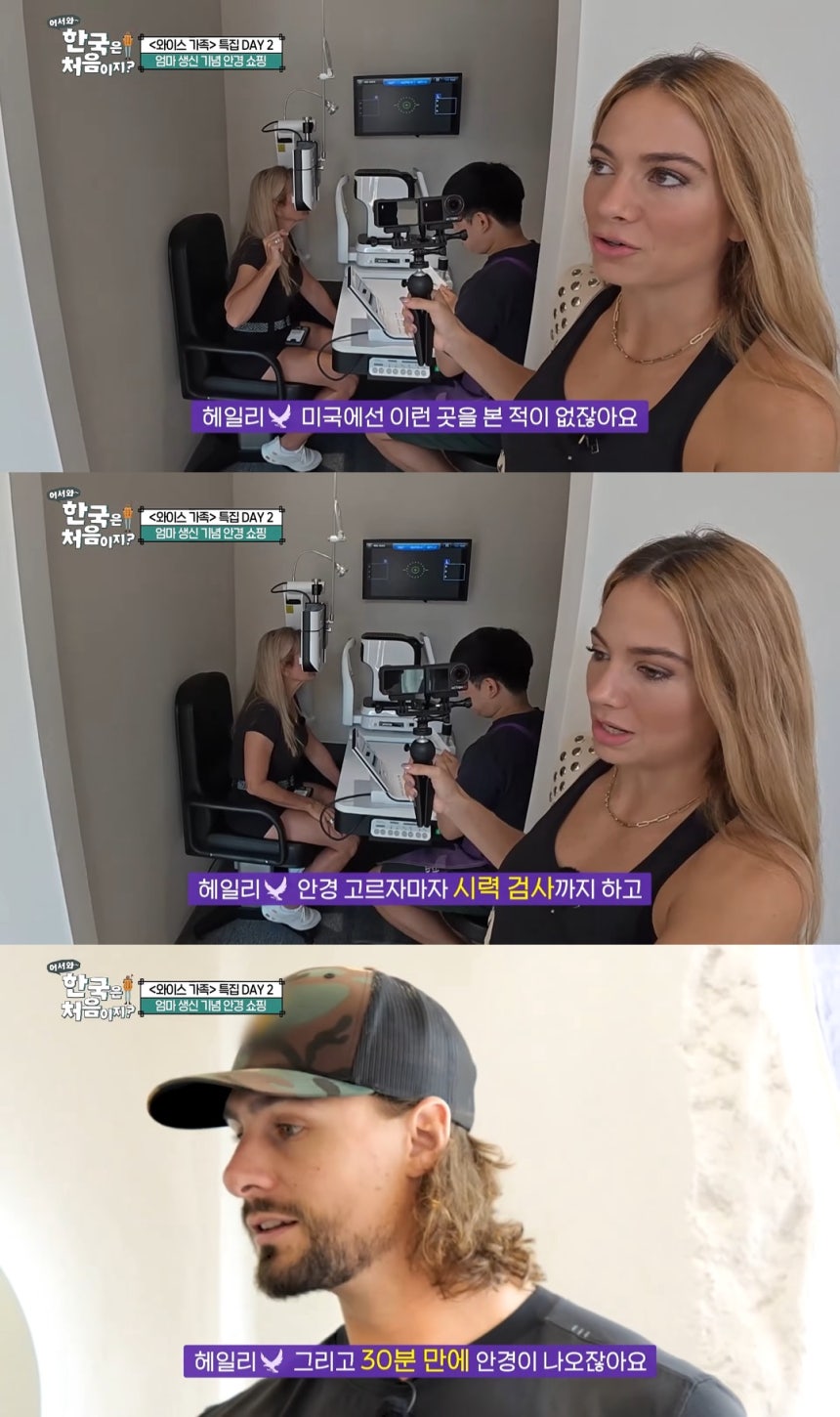 A screen capture from the show “Welcome, First Time in Korea?” (2017–) shows Hailey Brooke Weiss, wife of former Hanwha Eagles pitcher Ryan Weiss, visiting an optical shop in Korea with her mother and husband and talking about how fast it is to get glasses. SCREEN CAPTURE
Tourists getting prescription glasses while visiting Korea has become a common sight.
Glasses accounted for the third-largest share, or 12 percent, of retail purchases made using overseas credit cards between January 2023 and June this year, according to Korea Credit Data. Fashion topped the list at 28 percent, followed by convenience store purchases at 13 percent. The data is based on 328,000 stores nationwide that have at least one overseas credit card transaction each year during the period.
The popularity has also been rising over the years. Purchases of glasses using overseas-issued BC cards in 2025 rose 2.9 times from 2023, according to the credit card company.
Glasses ranked No. 3 in growth during the period, while retail ranked No. 1 with a 5.3-fold increase, followed by accommodation with a 3.4-fold increase.
Instead of having tourists search for optical shops on their own, travel platforms have also jumped on the trend by offering booking services.
Creatrip allows users to book eye exams and get discount coupons for optical shops via its platform, partnering with various optical chains including Davich Optical, Look Optical and Optic Life.
The booking service started in early 2025, and has since been expanding. Optical shop bookings between January and September rose threefold compared to the same period last year, with transactions rising tenfold, according to the company. The number of optical shops listed on Creatrip also rose fivefold during the same period.
Q. How is the process so fast?
It’s not just Korea’s famed ppalli ppalli (“hurry, hurry”) culture that makes getting glasses so quick. In many countries, the eye examination and the glasses fitting are handled as separate steps. But a single optician can oversee the process from the eye exam to fitting the finished glasses in Korea to streamline the process.
Korea's Act on Medical Technologists defines opticians as those who can dispense and sell glasses, sell contact lenses and conduct refraction tests.
But the roles are divided in many countries. Britain's National Health Service says dispensing opticians “fit glasses and contact lenses working from the prescriptions written by an ophthalmic practitioner or ophthalmologist” and “do not do eye tests.” Australia also separates the roles, with optometrists conducting eye exams and prescribing lenses, while optical dispensers interpret prescriptions and fit glasses.
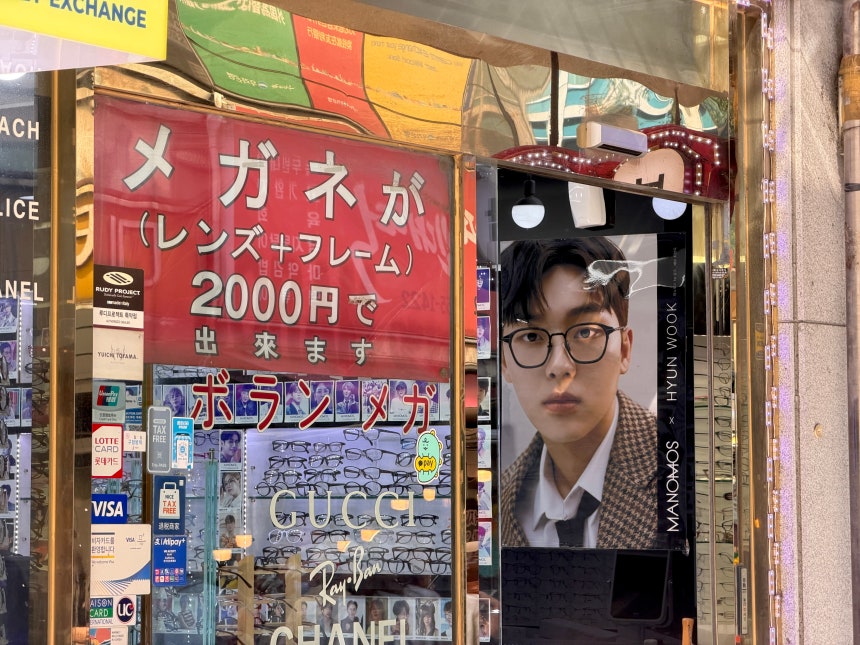 A sign reads that prescription glasses can be made for around 2000 yen ($12.7) at an optical shop in Namdaemun Market, central Seoul, on Oct. 8. LEE TAE-HEE
Edging, the process of cutting and grinding lenses to fit frames, is often outsourced to external labs in other countries, which adds to the wait.
In the United States, 40 percent of surveyed eyecare professionals reported sending more lenses to external labs for edging, while 47 percent said they were doing it more in-house, according to a July 2024 survey by Jobson Optical Research. The survey covered 216 eyecare professionals who use wholesale labs for lens processing or other eyewear products and services.
But in Korea, opticians handle edging, with lens edgers being standard equipment at optical shops.
Korean optical shops also tend to keep a wide selection of lenses in stock and make it easy to finish glasses on the spot, mainly because glasses are so widely worn in the country. A total of 71 percent of surveyed adults aged 19 and above in Korea wore glasses, according to a 2023 survey by the Korean Optometric Association. The survey covered 1,500 adults nationwide.
“Many optical shops in other countries stock lots of frames but not many lenses,” Sohn Jae-hwan, head of Mooguk Optics, said in a video uploaded to the store’s YouTube channel. “But Korean shops keep a lot of lenses in stock because customers don’t want to make multiple trips and want things done quickly.”
Q. How did Korea build its eyewear industry?
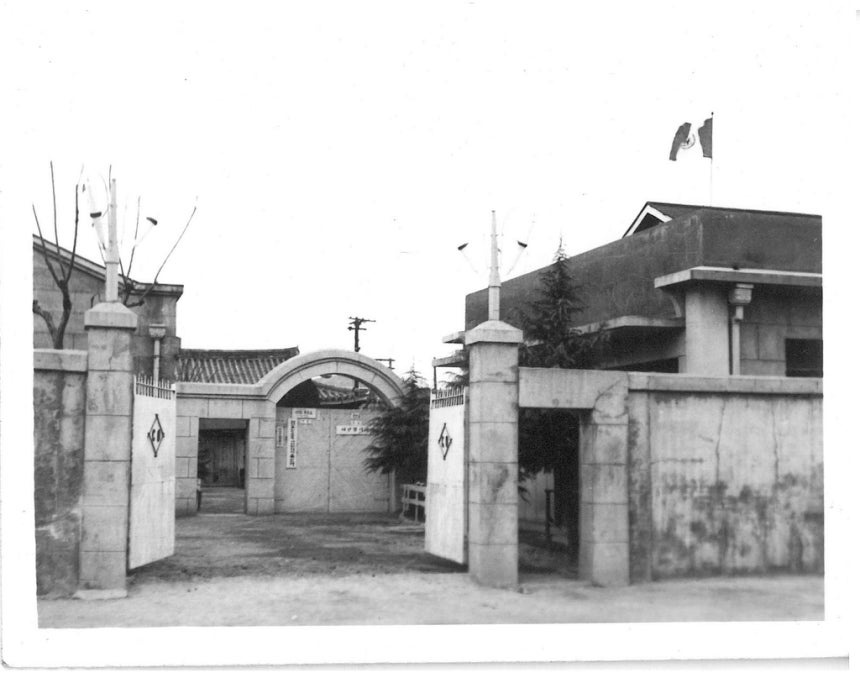 A file photo of the Gukje Celluloid Industrial factory in Daegu DAEGU METROPOLITAN CITY
Glasses have been worn in Korea for centuries, but the modern optical industry took shape in the early 20th century. Korea's first modern optical shop, Myeongandang, was founded in 1920 in the Jongno area of central Seoul.
Daegu was a major hub, with Gukje Celluloid Industrial opening in its Buk District in 1946 as Korea's first eyeglass frame manufacturing factory and paving the way for others to follow. The first lens manufacturing factory was also built in the city in 1973.
As Korea industrialized and fervor for education grew, demand for vision correction also rose and helped the eyewear industry grow. Koreans also replace glasses often, helped by more than just the speed.
Prescription glasses and contact lenses qualify for a medical expense tax credit under Korea's year-end tax settlement system, which can encourage people to change glasses once in a while. People also rushed to buy glasses with government-issued consumption coupons provided in July 2025. Sales at optical shops rose 56.8 percent during the first week the coupons were given compared to the previous week, the largest increase among all categories.
Q. Is language a barrier for foreigners?
Speed isn't the only thing that makes getting prescription glasses convenient for tourists. Many optical shops in major tourist neighborhoods also offer language support to make things easier.
Walking around Myeongdong, optical shops frequently displayed signs in English, Chinese and Japanese and advertised that consultations were available in those languages. Similar promotions for language support could also be found in stores in Hongdae in western Seoul and in Namdaemun Market in central Seoul.
At Davich Optical's Myeongdong branch, pamphlets explaining the eye exam process and glasses price range in English, Chinese and Japanese were laid out next to the entrance. A sign in front of the store also said consultations were available in the three languages, with opticians busy assisting customers of various nationalities inside.
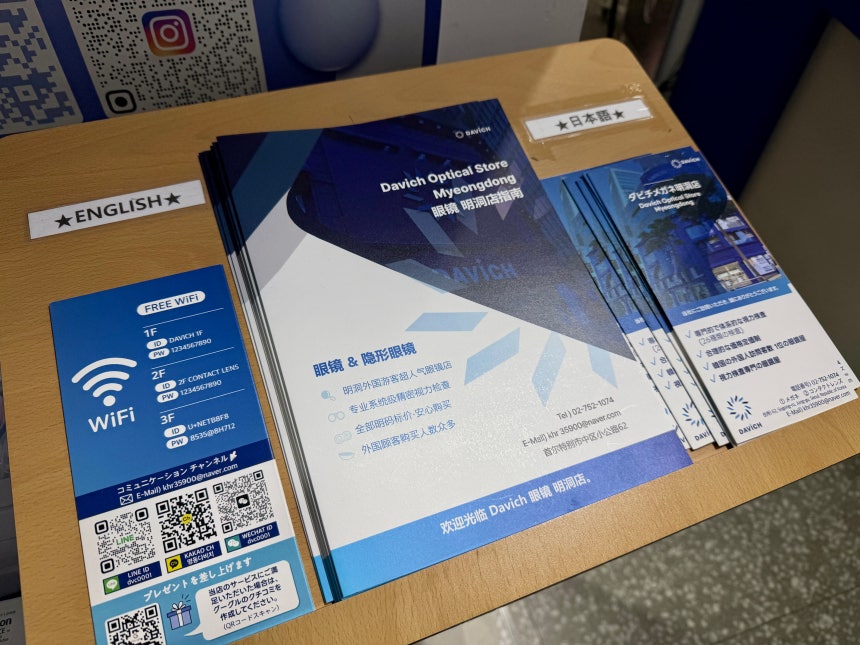 English, Chinese and Japanese pamphlets are laid out at Davich Optical's branch in Myeongdong, central Seoul, on Oct. 6. LEE TAE-HEE
"Around 60 to 70 percent of our customers are foreigners, although it does vary by month, and most come from the United States and also a lot from Europe," a staff member at the branch said. "The staff all generally speak English and we have designated people in charge of other languages like Japanese or Chinese and assist customers based on the desired language."
Creatrip also lists languages available for consultations for each optical shop on its website.
Angie, from the Netherlands, visited another optical shop in Myeongdong on Oct. 6 and had her consultation in English. She had come to the shop with a few Korean phrases prepared just in case, but quickly found that there was little to worry about as the staff spoke in English.
"They're much more friendly here and asked what I wanted, showed me the frame options and checked if the frames sat well on my face," she said. "I live in the Netherlands and getting glasses is also expensive there, but I like this experience more."
Q. Are all glasses ready in 30 minutes?
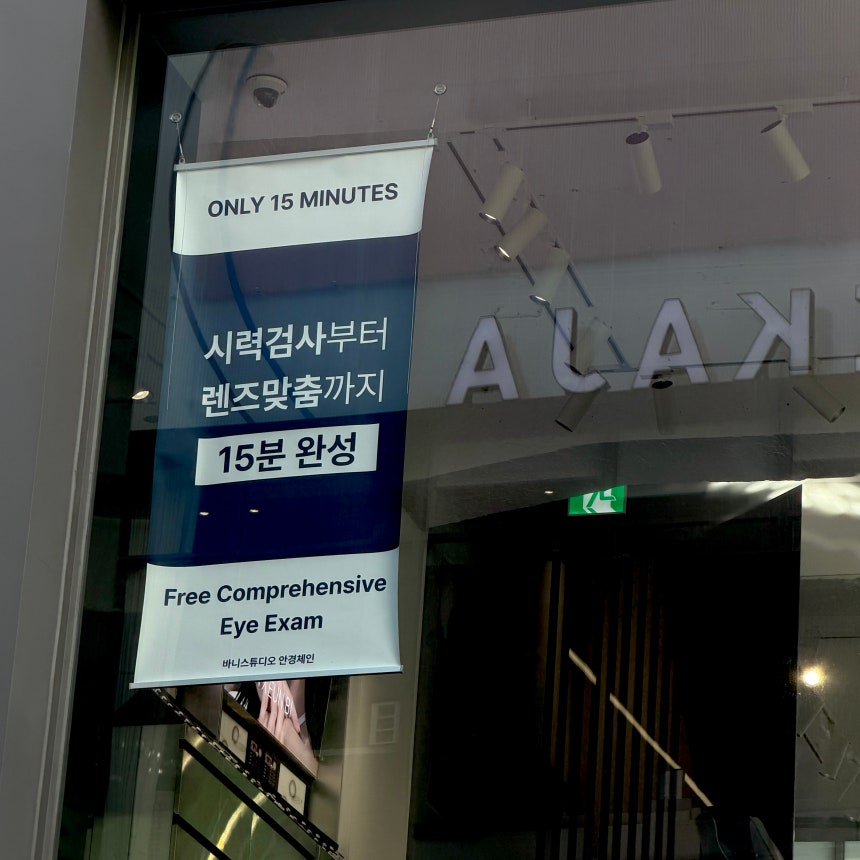 A sign reads that only 15 minutes is needed for an eye exam and glass prescription process in Myeongdong, central Seoul, on Oct. 6. LEE TAE-HEE
While Korea is fast, not all glasses can be made in a matter of minutes. Some can take longer depending on the type of lens and prescription, or if the optics store does not have them in stock. But the wait is still faster than the norm in many other countries.
Daisy’s lenses were more complicated, so she would pick them up the next day. “But it’s still way faster because I would have to wait at least two weeks in Germany,” she said.
Optical shops typically receive lenses ordered from manufacturers within a day or two, even when they do not have a particular prescription in stock.
Proximity to major lens suppliers can speed things up, with many lens wholesalers clustered around Namdaemun Market. A long street in the middle of the market is even nicknamed eyewear street, with around 150 optical shops and wholesalers calling it home.
"Even if we're out of certain lenses, because Namdaemun has a lot of lens wholesale suppliers, we can just quickly get them from nearby and make the glasses," said an optics shop owner in Namdaemun Market. "The shops here have been around a long time and are all highly skilled, and we almost always get the glasses ready within 30 minutes."
Q. Can the eyewear industry keep its edge?
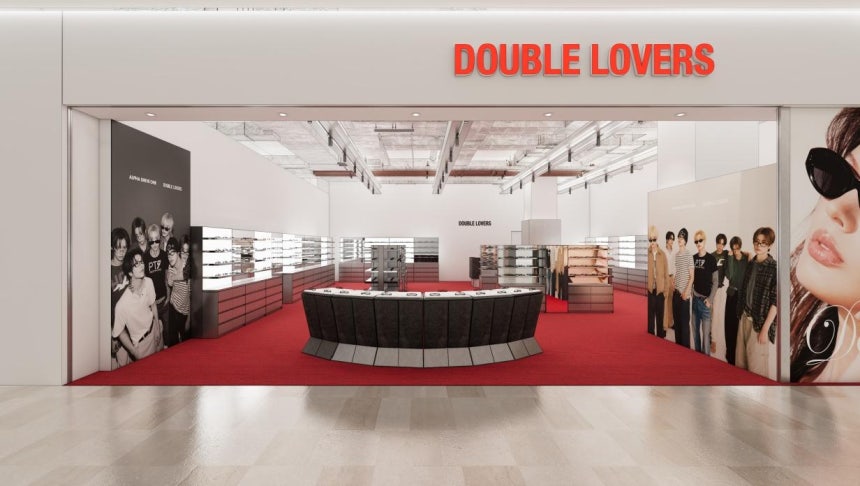 A pop-up store for eyewear brand Double Lovers in Lotte World Mall in Songpa District, southern Seoul. LOTTE DEPARTMENT STORE
Advances in vision correction, including Lasik surgery, have given people an alternative to glasses. But demand for glasses in Korea continues to be strong as vision problems become more prevalent among children and teenagers.
A total of 58.25 percent of elementary, middle and high school students had vision problems in 2025, up 1.21 percentage points from the previous year, according to data compiled by the Ministry of Education. The data covered 92,620 students nationwide, with the figure rising since 2022.
The market has also expanded beyond vision correction as people want to add a bit of style to their everyday look.
Eyewear brands such as Gentle Monster, Blue Elephant and Double Lovers have tapped into such demand with fashion-forward designs. Their stores can easily be spotted in the trendy neighborhood of Seongsu-dong in eastern Seoul, with tourists frequently walking out with frames they purchased.
Fashion retailer Musinsa has also eyed the market, filing trademark applications for Musinsa Standard Eyewear in Korean in September last year and in English that December.
"Blue Elephant has established itself as an affordable K-fashion eyewear brand among younger consumers and foreign tourists, with glasses priced in the 50,000 won range," Lim Jeong-eun, an analyst at KB Securities, said. "Its focus on sales in trendy districts including Seongsu-dong, Hongdae, Yeonnam-dong [of western Seoul] and Myeongdong has been a key factor in its success."
"Competition is intensifying as the K-eyewear market grows in size and popularity, with new players such as Musinsa Standard Eyewear trying to enter the market," Lim added.