 Contestants engage in a writing contest as part of the King Sejong Institute Foundation’s annual training program on Oct. 7. KING SEJONG INSTITUTE FOUNDATION
For more than two decades, the Test of Proficiency in Korean (Topik) has been the benchmark for international residents seeking to demonstrate their Korean-language proficiency, with scores used for university admission, scholarship and visa applications, as well as employment.
But as more international students and professionals pursue academic and career opportunities in Korea, access to the test has become a concern for some learners. Demand sometimes outstrips available spots, with securing a test slot often likened to competing for K-pop concert tickets.
In response to growing demand, the number of alternatives is also expanding.
Universities are being given greater flexibility in administering their own language proficiency tests, while the Sejong Korean Language Assessment (SKA), developed by the King Sejong Institute Foundation, has been expanding the number of test centers and testing opportunities available to learners overseas.
Introduced in 2022, SKA drew a record number of 6,424 test takers last year, nearly three times the 2,207 recorded in its first year.
As the test expands, its differences from Topik in recognition, test format and accessibility offer a basis for assessing its potential as an alternative for Korean learners.
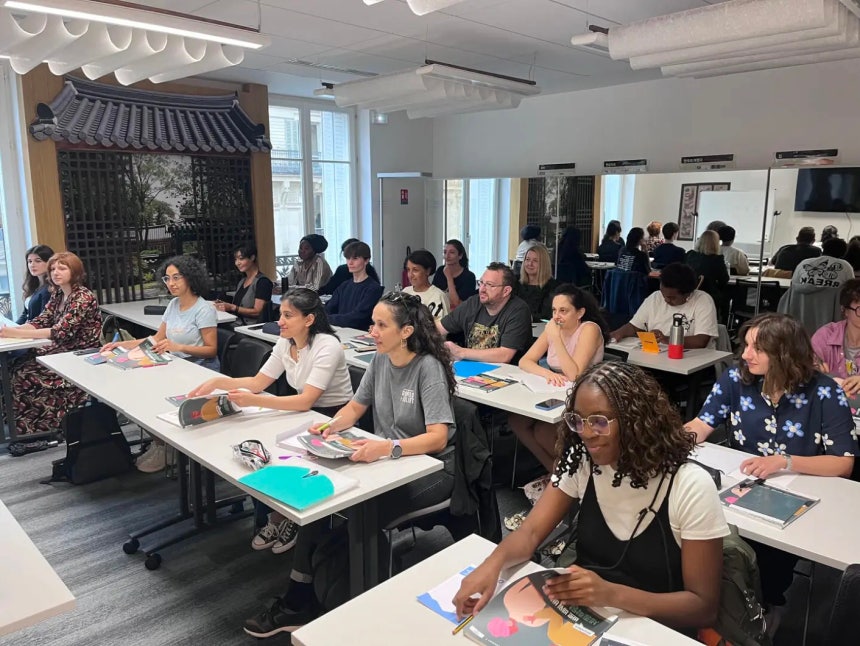 Students take Korean classes at the King Sejong Institute Foundation in France in September 2024. KING SEJONG INSTITUTE FOUNDATION
How is SKA different from Topik?
While the regular Topik exam covers listening, reading and writing, speaking is tested through a separate component, Topik Speaking. SKA, however, combines all four skills in a single test, which could particularly appeal to learners who want their speaking ability reflected in their overall proficiency assessment.
“One of the reasons why I took the SKA is that I’m more confident in speaking and that counts into my overall score,” Ngoc Khanh, a 21-year-old Vietnamese college student, said in an interview with the Korea JoongAng Daily.
For learners like Ngoc, who are more confident with their speaking ability, Topik’s separate speaking test might seem like another good alternative.
Or at least it would if it were more accessible.
While SKA is offered at more than 70 King Sejong Institutes worldwide, Topik Speaking has not been administered overseas since its introduction in 2022, leaving learners abroad with virtually no opportunity to take the test.
For many people taking a Korean-language proficiency test to study or work in Korea, Topik Speaking is therefore an unrealistic option, making SKA’s inclusion of speaking significant.
The two assessments also use different approaches to measuring Korean language ability.
According to the official descriptions of the two tests, Topik is based more on academic and career-related materials, while SKA is designed to measure Korean communication skills in everyday life, with questions based on real-world settings.
That difference is reflected in the types of questions on each test as well.
A review of official sample questions and released materials shows that Topik’s reading section frequently asks test takers to match information in academic passages, interpret graphs and understand the meaning of newspaper headlines.
While SKA also tests comprehension and inference, its questions more often place those skills in everyday situations, including picture-based questions and questions about the location or situation of a conversation.
“Comparing the two tests, as I’m now preparing for Topik, I think the clearest distinction is the reading section,” she said. “Topik’s reading passages use a lot of vocabulary used in college classes, while SKA uses daily vocabulary.”
“So, SKA just came off as more suitable for me, because I’m more confident with daily conversation and casual reading,” Ngoc added.
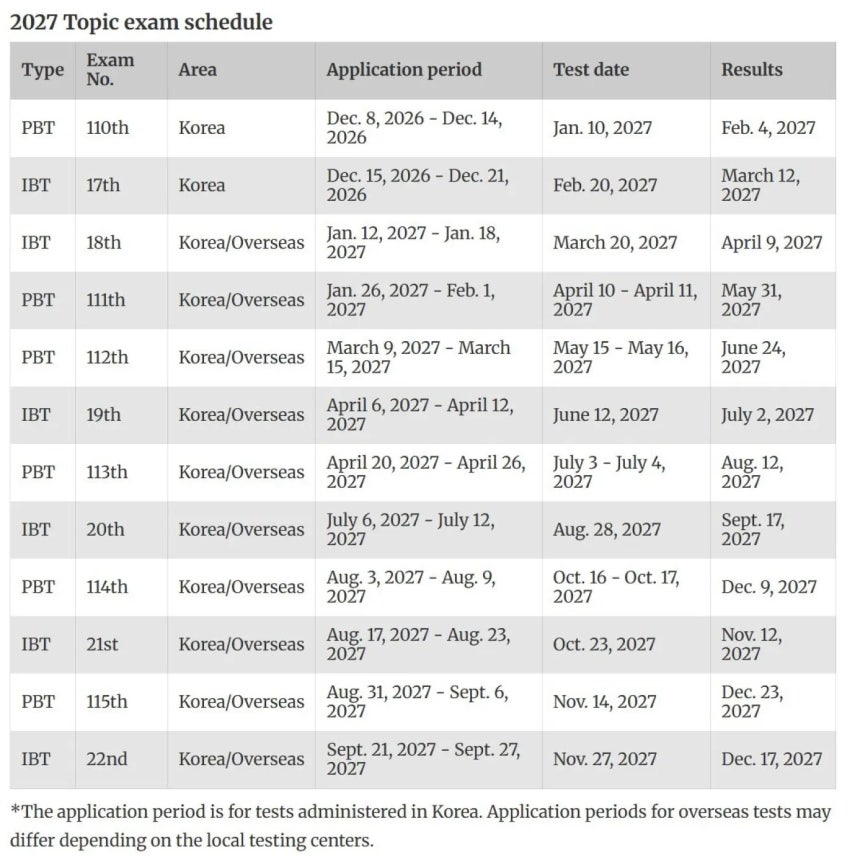
The cost, duration and registration of the tests
The two tests differ in their schedules, registration procedures and fees.
The 2027 Topik schedule, announced on Sept. 29, includes 15 administrations: six paper-based tests, six internet-based tests and three speaking assessments. The calendar specifies individual test dates, while registration periods for applicants in Korea and overseas are listed separately. Overseas applicants should check the schedule for their country or region on the official Topik website, as local registration arrangements vary.
Topik is administered at designated test centers, including university campuses, Korean diplomatic missions and Korean Cultural Centers overseas.
The SKA, meanwhile, had three regular administrations scheduled for 2026, on March 14, June 6 and Sept. 5, with the schedule for next year's tests yet to be released.
Applicants can register through the official SKA website, with testing available at over 70 designated King Sejong Institutes and other official assessment centers worldwide. Specific test locations vary by administration and should be confirmed through the official SKA website.
The tests also differ in cost.
The paper-based Topik costs 40,000 won ($28) for Topik I, intended for beginners, and 55,000 won for Topik II, designed for intermediate-to-advanced learners. The internet-based tests cost 70,000 won and 95,000 won, respectively. The separate Topik Speaking assessment costs 80,000 won.
SKA, on the other hand, is offered free of charge, removing the examination fee as a barrier for learners considering the test.
 Participants take the Test of Proficiency in Korean, widely known as Topik. CHO MOON-GYU
Which one carries more weight?
For students deciding which Korean test to take, however, the most decisive factor may not be whether the test includes a speaking component or what types of questions it has.
It may simply be a matter of which test is more widely accepted.
That is where Topik has its edge.
While most domestic universities and companies specify required Topik levels in their admission guidelines and job descriptions for international students, SKA’s institutional presence has yet to reach the same level of recognition.
A review of the admission guidelines for the coming year at 10 major universities in Seoul — Seoul National University, Yonsei University, Korea University, Hanyang University, Sungkyunkwan University, Kyung Hee University, Ewha Womans University, Hankuk University of Foreign Studies, Chung-Ang University and the University of Seoul — found that all 10 listed universities accepted Topik scores as language proficiency requirements for admission.
However, only Korea University and Kyung Hee University explicitly listed SKA scores as an accepted alternative in their admission guidelines.
University officials did not point to differences in the tests’ reliability or difficulty, suggesting instead that the gap may reflect Topik’s years of established partnerships with universities and SKA’s still-growing, relatively limited presence.
“It’s not because our admissions team thinks SKA is less reliable than Topik. It’s just that we haven’t really reviewed accepting SKA as a language requirement,” an official of a Seoul-based university told the Korea JoongAng Daily. “However, Topik has been used for years as a matter of convention, not only at our university but also at other institutions and companies.”
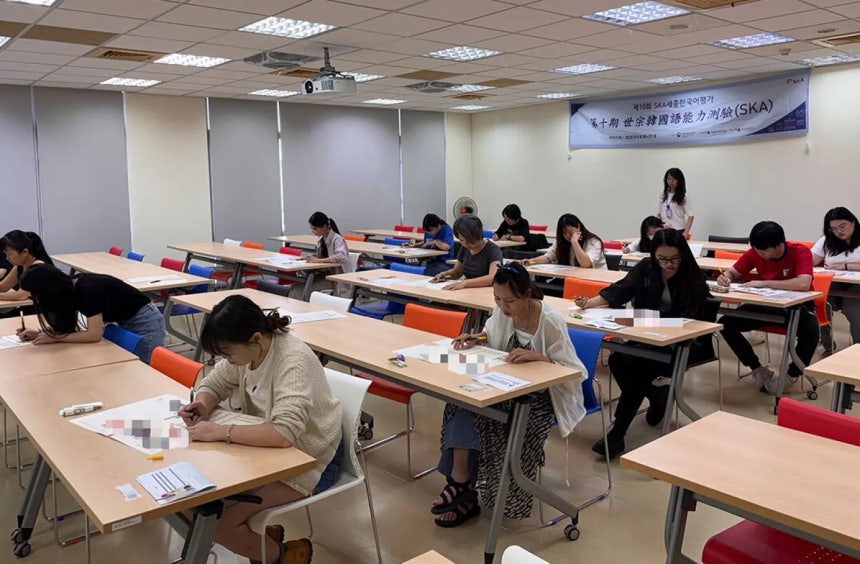 People take the 10th Sejong Korean Language Assessment held in September 2025, at the King Sejong Institute Foundation's branch in Tainan City, Taiwan. KING SEJONG INSTITUTE FOUNDATION
Will the gap between the two tests narrow?
Based on reviews of official applications, Topik seems to have a clear advantage in practical reach.
However, officials at the King Sejong Institute Foundation say they have been working to narrow the gap.
The foundation’s spokesperson told the Korea JoongAng Daily that it has been expanding the assessment’s use beyond language testing and into universities, companies and government institutions.
As part of the effort, the foundation has formed partnerships with domestic and international universities in recent years.
In addition to Korea University and Kyung Hee University, the foundation formed partnerships with Yonsei University’s Global Leaders College and Kookmin University, as well as with international universities such as Vanderbilt University and the University of Missouri in the United States and Vilnius University in Lithuania, according to official statements released last year.
The expansion is also beginning to reach beyond the education sector.
The King Sejong Institute Foundation said it has also signed partnerships with public organizations and firms, including the Korea Trade-Investment Promotion Agency, education company Daekyo and the Korean Embassy in Uzbekistan, so they will accept SKA scores when recruiting new talent.
“Since launching the SKA, we have been working to enhance the test’s accessibility and credibility,” a spokesperson for the foundation told the Korea JoongAng Daily. “We are actively building partnerships with universities, as well as enterprises, to ensure that SKA scores are widely recognized for both admissions and recruitment.”
“While there may still be differences in the extent to which SKA is used compared with existing Korean-language tests, we will try our utmost to expand its use,” the spokesperson added.