IMA 뉴스
키워드 IMA 결과입니다.
-
 생활
생활치매는 관계가 끊길 때 빠르게 깊어진다
[이윤현의 보건과 건강] 국가가 나서 노인의 사회적 연결 강화해야 새로운 지식은 뇌를 자극해 치매 예방에 도움이 된다. GETTYIMAGES 올해 90세인 부친은 한때 집에 오는 길을 잃곤 했다. 초기 치매 진단을 받았을 때 가족은 크게 흔들렸다. 그런데 주간보호센터를 3개월 다니며 놀라운 변화가 생겼다. 식탁에서 가족에게 “요즘 어떻게 지내?”라고 묻고, 끝까지 대답을 듣는 모습이 돌아왔다. 치매는 관계가 끊길 때 더 빠르게 깊어지는 병이라는 사실을 그때 절감했다. 미국 하버드대 의과대학이 지난해 발표한 연구 결과에 따르면 친구를 만나고 자원봉사를 하는 등 관계성을 유지하면서 사회 활동을 하는 노인은 그렇지 않은 또래보다 치매 진단을 평균 5년 늦게 받았다. 평균 80세 노인 약 2000명을 7년간 추적한 이 연구는 사회적 연결이 인지 건강의 강력한 보호막임을 알려준다. 5년은 짧은 기간이 아니다. 한국은 치매 환자 100만 명 시대를 앞두고 있다. 관련 의료비와 간병비는 계속 늘어나는 추세다. 현재 기준으로 환자 인당 연간 약 2000만 원 수준이다. 노인 100만 명의 치료 시작 시점이 5년 늦어진다면 국가가 절감하는 의료비는 2조 원이 된다. 사회 전체 부담이 크게 줄어드는 셈이다. 따라서 치매 예방은 개인에게 맡길 일이 아니다. 노인들이 관계성을 강화할 수 있도록 국가 차원의 정책 설계가 필요하다. 하나의 해법으로 제시할 수 있는 것이 무상 교육이다. 은퇴 후 학위과정을 밟거나 직업교육을 받고 싶어 하는 시니어의 교육비를 국가가 지원하는 것이다. 새로운 지식, 새로운 사람, 새로운 일상은 뇌를 지속적으로 자극한다. 50~70대를 강의실로 돌아가게 하는 것은 치매를 늦추는 가장 효과적인 투자다. 동시에 청년인구 감소로 재정난에 처한 대학을 살리는 효과도 볼 수 있을 것이다. 노인을 보호 대상에서 생산 주체로 강조할 것은 교육 지원은 끝이 아니라, 출발점이라는 점이다. 배운 것을 실제로 사용할 기회를 일자리와 연계해 제공해야 한다. 규칙적으로 사람을 만나고 책임을 지는 구조를 만드는 것이 중요하다. 사회에 다시 참여하는 순간, 노인은 보호 대상이 아니라 생산 주체가 된다. 물론 신체 기능이 떨어진 이들을 위한 주간보호센터, 방문케어 등도 중요하다. 하지만 그보다 앞서 필요한 것은 노인이 배움 문턱에서 좌절하지 않도록 하는 일이다. 교육, 직업, 일자리, 돌봄이 선순환적으로 이어져야 진정한 치매 국가책임제가 완성된다고 할 수 있다. 필자 부친의 웃음은 약에서 온 것이 아니다. 자신이 누군가에게 필요한 사람이라는 자각에서 왔다. 치매를 늦추는 가장 강력한 처방은 배움, 일, 그리고 관계다. 국가는 바로 그것에 투자해야 한다. 노인에게 대학 문을 열고, 직업교육을 무상으로 제공하며, 다시 일할 기회를 주는 것. 이것이 ‘치매 인구 100만 시대’에 대비하는 가장 인간적이고도 경제적인 길이다.
연구 결과치매 환자정책 설계의과대학IMA -
 생활
생활In Seoul’s backstreets, Mr. Tongue turns a fleeting mark into a citywide language of faith and free art
The elusive street artist behind Seoul’s recurring tongue motif reflects on anonymity, spirituality and how street art quietly reshapes Korea’s urban landscape. A mural by street artist Mr. Tongue featuring the artist's signature tongue image MR. TONGUE For the observant resident or traveler, the thing that most frequently catches the eye in Seoul may not be a famous landmark or a cluster of teenagers dancing to K-pop in a plaza, but the image of a tongue — the signature motif of the graffiti artist known as… Mr. Tongue. The artist, who has largely remained in the shadows, has put up several hundred street pieces across Seoul and other cities in Korea. Hailing from the United States and based here for more than a decade, he prefers to let the work introduce him beyond that, remaining anonymous throughout his career. A passerby looks at a mural by street artist Mr. Tongue MR. TONGUE The image of the tongue was born in New York in 2010, in a city that Mr. Tongue found gray, dull and hard in the way New York famously is. He had drawn since childhood and written graffiti for years — all of it letter-based, which had begun to feel like a dead end. “For me, I always felt a certain limitation when it came to letters, because it’s hard to deliver a certain message if you are just writing your name, just writing letters,” Mr. Tongue said during an interview with the Korea JoongAng Daily. “There’s so much intricacy and detail in that, but for me personally, that’s not what caught my attention. What caught my attention was using an iconic symbol or character to portray a certain message to the public.” What was around him at the time made the case. JR, the French artist, was pasting portraits blown up to the size of buildings, overnight and without permission. Banksy was deep in his rat period. The placements, the colors, the repetition of a single mark across a city — that was the lesson. Arriving at the tongue was a process of elimination. Mr. Tongue wanted expression, and expression meant the face, so he went down the list: eyes, nose, eyebrows, ears. Each felt as limited as a letter. The mouth brought him to the Rolling Stones logo, which had the right instinct but read to him as too feminine in its lips; the teeth said almost nothing. “And then I came to the tongue, and I started researching the tongue, because I saw the simplicity of it but also the complexity of it,” he said. He drew a first version on a Post-it note — nothing like what it has since become — and started placing it on mugs, televisions and refrigerators, to see how it behaved. Even without a face, the tongue was doing something an eye could not: witty, playful, or in-depth, depending on where it landed. Research followed, first into the biology, then the spiritual, which is where it locked. The tongue is capable of speech, appetite, mockery, aggression and prayer, and over 15 years it has moved between them. At the start it was speech, loudly. A friend once told Mr. Tongue that during his most active period of "bombing" — painting illegally, in volume and at scale — it looked less like painting than shouting. “[My friend] said it looks like you’re screaming, but it seems like now, now that I've made a slow transition, it seems like now ‘you're okay with a gentle whisper,’” Mr. Tongue recalled. “And so when my friend said that, that really sparked something in me.” The whisper takes more patience than the scream. Mr. Tongue scouts locations days and sometimes months in advance, and once there he waits — until a car or a pedestrian passes by, for hours if that is what the wall requires. This wasn't a change of temperament, not a natural virtue. He used to go, do it and leave, spectators be damned. The waiting is what lets the work continue. Street artist Mr. Tongue paints a mural on a street, in this photo provided by the artist MR. TONGUE Where the tongue goes, which locations he chooses to paint, is a decision he makes alone and privately. Mr. Tongue is a Christian believer, and it is his faith that tells him which wall is the one. Which walls that process produces is unusual. Artists usually want the most visible surface with the heaviest traffic. Mr. Tongue often ends up in front of a moldy wall in the corner of a backstreet, and takes it. “I really believe in the power of free art,” he said. “But in order for art to be truly free, it has to be in your everyday walk. Even if an entry fee is free, you have to pay for a taxi ride or gas to get there — or even if somebody dropped you off, it's still your time, and time is money.” A piece encountered on the way to the convenience store is, by Mr. Tongue’s account, the only kind that is actually free. A main street wall piece may last 10 years and an alley one just a week; he is not prepared to say what that week did for the people who passed it. Although Mr. Tongue painted in any spot that his faith chose in the early days of his career, now — as an established street artist — he paints in legally allowed spaces and private properties upon commission. Mr. Tongue’s reading of the city of Seoul has changed more than anything else. For years he was too focused on announcing his existence to look around; it could have been Seoul, it could have been Busan. Now he can tell the neighborhoods apart by their stations and their color sense. A piece in Jung District in central Seoul, on the road running toward Myeongdong, was pitched for tourists — it was intricate, subtle and flowing rather than aggressive. A piece in Nowon District, northern Seoul, where Seoul stops and the mountains start, used greens and blues for water and trees, pink and yellow for the light hitting them — the colors the neighborhood already knows. A mural by street artist Mr. Tongue is seen on a street in Seoul, in this photo provided by the artist MR. TONGUE The artist treats Seoul’s visual density — the signage, the cables, the vents — as material rather than as an obstacle. Early on, Mr. Tongue squeezed into the nooks left between air conditioning units and bus stop signs, sometimes matching his colors so the piece half-disappeared: a lighter blue beside a blue trash bin, green on a wall behind trees. The current approach reverses that. In a visually quiet neighborhood, he uses a complex design to draw the eye. In a chaotic one, he strips it down until the simplicity is what stands out. Mr. Tongue is equally deliberate about the separation between himself and the persona, which he has protected since before the first tongue went up. He has watched other artists get absorbed by the identities they built, and he thinks about athletes — how an injury or age takes away not just a career but a self. “I have to just kind of keep telling myself that this is not who I am, this is what I do,” he said. “Other people automatically assumed it was my identity, because people assume this is who you want to be. But actually this was just my channel.” The motif itself has never felt like a cage. When a subject resists the tongue, he treats that as evidence of his own limitations rather than the tongue’s — the piece in northern Seoul after the invasion of Ukraine, a peace sign in Ukrainian colors, came of refusing to slap the motif onto a flag. It is, to his surprise, still running. A mural by street artist Mr. Tongue is seen on a street in Seoul, in this photo provided by the artist MR. TONGUE On the state of the graffiti scene in Korea, Mr. Tongue is blunter than one might expect. The activity level has gone down, not up, and more artists have taken the commercial, safer route than a decade ago. The exhibitions that now exist are largely organized by the artists themselves, which he does not see as a sign of health. “That’s how much lack of support we actually have,” Mr. Tongue said. “The artists themselves have to put on events, rather than organizations putting it on and inviting the guests. There’s a lot of logistics that go on that are a lot more complicated, and it takes away the artists from being true artists.” Enforcement has hardened over the same period, which he connects to the country’s rising profile: the more Korea is looked at, the more graffiti is read as an attack on the image. He thinks the real objection is simpler than reputation — it's that this is the one thing on the street that cannot be controlled, which is more or less the definition of the form. The piece Mr. Tongue thinks about most is one that no longer exists — a large work on a water tower visible from the Gangbyeon Expressway, up about a year before someone painted it out. He had placed it above another artist’s work without touching it, a gesture of respect he picked up from Shepard Fairey, who goes around another artist’s work or skips the wall. When Mr. Tongue’s work on the water tower was covered, the work below it was left untouched. Street artist Mr. Tongue paints a mural on a street with a colleague, in this photo provided by the artist MR. TONGUE The title he had given the work was “Babel,” after the tower in Genesis of the Bible that people built out of arrogance to reach God. “I knew that piece was going to run for 10, 20, 30 years,” he said. “So I was like, okay, I’ve secured a spot in Seoul that you can see from the highway for as long as this tower exists. And basically the mentality was, I’m going to be the most superior guy in all of Seoul.” He could not have answered that honestly a few years ago. A reckoning of sorts came after a fall through the roof of a second-story building while painting in Indonesia, which left him with scratches and no broken bones, and then three months of holding a can and finding that nothing came out. In the ordinary course of things, a buffed piece is answered by covering someone else’s, and that cover by another, until it stops being about the wall at all. Mr. Tongue, however, is at peace with the people who painted over his. He knows them. Cans of paint and brushes used by street artist Mr. Tongue are seen in this photo provided by the artist MR. TONGUE Erasure is the game in any case: landlords change, neighborhoods are demolished, and an artist who took each one personally would not last. What has lasted is the readership. Visitors here for a few months or a few years have told him that running into the tongue on a commute, or on a trip to Jeju, became a kind of companionship in a lonely stretch. Others hunt for pieces across districts in small groups, comparing finds like real-life Pokémon Go. Mr. Tongue recently finished a five-year project, not yet public, painting in every city in Korea — most of which have never had street art of any kind, where people stop to watch and occasionally pick up a can just to hold it. He is not planning to repeat the project. He would rather it made someone else restless. “Let me be the example, so that the youth in these different cities can see it, and maybe it sparks an idea — ‘Hey, I want to paint,’” he said. “There are so many talented, skillful creatives out here. They just don’t know exactly how, or what they even want to do.” If his images, now a representative part of Seoul’s — and Korea’s — streets, can inspire that way, Mr. Tongue would be content.
PERESSCIAWHOIMA -
![[단독]제초 작업하던 군인 신발에 총알 날아와 꽂혀…육군 “발생 경위 조사 중”](https://imgnews.pstatic.net/image/032/2026/07/30/0003461280_001_20260730063109407.jpg?type=w860) 사회
사회[단독]제초 작업하던 군인 신발에 총알 날아와 꽂혀…육군 “발생 경위 조사 중”
일러스트 | NEWS IMAGE 육군학생군사학교 사격장 인근에서 제초작업을 하던 군인 신발(전투화)에 총알이 날아와 꽂히는 사고가 발생했다. 인명피해는 없었지만 군 당국은 사고 경위 파악에 나섰다. 29일 경향신문 취재를 종합하면, 지난 2일 오전 충북 괴산군 육군학생군사학교 사격장에서 학생군사교육단(ROTC) 후보생들이 개인화기 사격훈련을 받았다. 사격 도중 사격장 밖에서 사고가 발생했다. 사격장과 다소 떨어진 곳에서 예초기로 풀베기 작업을 하던 간부 A씨 전투화에 느닷없이 총알이 날아들어 박힌 것이다. 천만다행으로 A씨가 부상을 입지는 않았다. A씨는 전투화에 총알이 박힌 것을 확인해 보고했고, 당일 사격 훈련은 중단된 뒤 취소됐다. 군 당국은 사격 훈련 중 정상 발사된 탄환이 사격장 밖까지 넘어갔을 가능성, 사격 훈련 과정에서 오발된 탄환이 사격장 밖 지역을 향했을 가능성 등 원인을 파악 중이다. 육군 관계자는 “현재 군 수사기관에서 총기 정밀 감식을 하고 탄두의 유입 경위 등 정확한 발생 경위를 조사하고 있다”고 밝혔다. 육군은 사고 발생 직후 안전 조치를 취하고 재발 방지 대책을 시행하고 있다고 밝혔다. 사고 원인이 규명되면 그에 따른 맞춤형 대책 등을 추가로 검토한다는 방침이다.
IMA사고중단아들경위 -
 국제
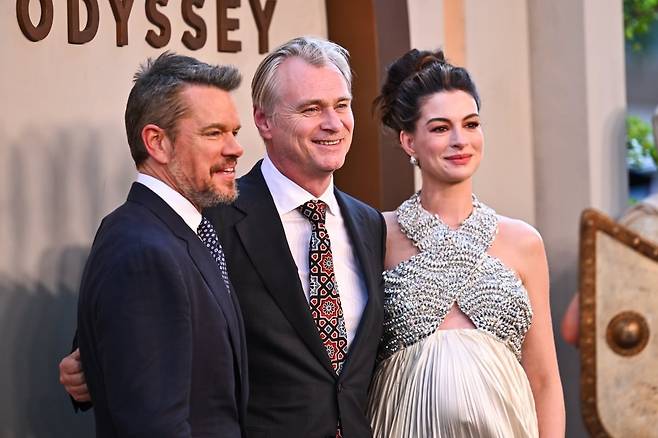
국제아시아 개봉 전인데 6억 달러…놀란이 놀란 한 '오디세이'
사진=AP 크리스토퍼 놀란 감독의 신작 '오디세이'가 개봉 2주 만에 글로벌 박스오피스 6억 달러를 돌파했다. 26일(현지시간) 미국 버라이어티 등 외신에 따르면 영화 '오디세이'는 전 세계에서 누적 수입 6억 3960만달러(한화 약 9335억원)를 거둬들였다. 3시간의 러닝타임과 R등급이라는 조건 속에서 거둔 성과다. 이 작품은 기원전 8세기 호메로스가...
미국중국한국일본독일프랑스아시아주가20억원AX달러사의흥행아시아 시장IMA -
아직 공개된 뉴스가 없습니다.
새 기사가 준비되는 대로 이곳에 표시됩니다.